
Marina Warner
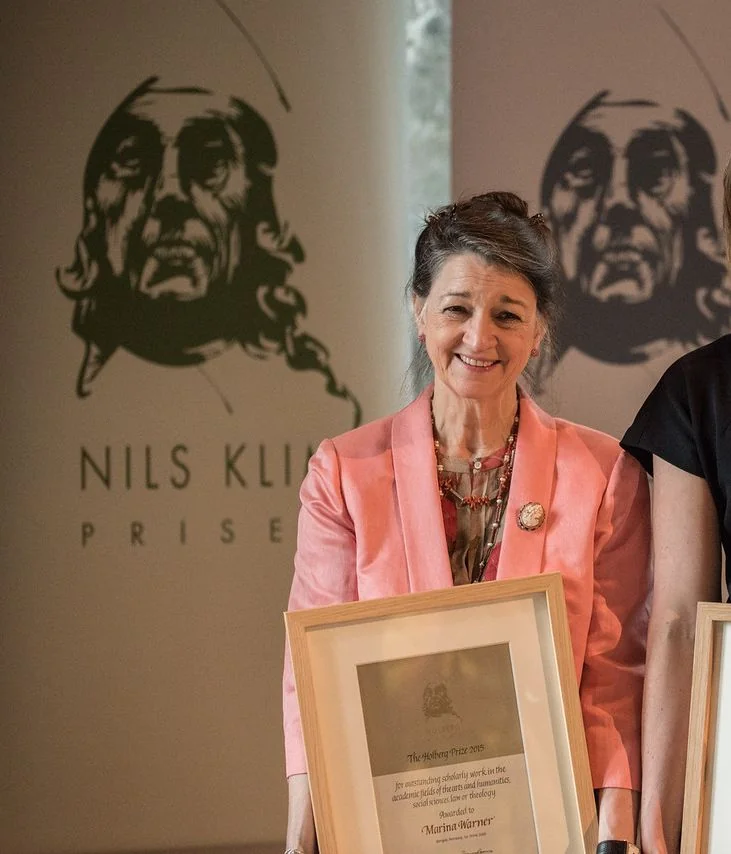
Image from Wikipedia
Image from Wikipedia
Marina Warner: The Great Storyteller of Myths, Fairy Tales, and Female Imagery
An author whose work connects literature, cultural history, and contemporary thought
Marina Warner is one of the most influential British intellectuals of her generation. As a literary scholar, essayist, mythologist, novelist, and cultural critic, she has created a body of work that engages with religious imagery, fairy tales, symbols, and female archetypes. Her thinking moves between academic precision and narrative power, between historical analysis and poetic imagination. ([marinawarner.com](https://www.marinawarner.com/about/))
Born in 1946 in London and raised by an Italian mother and an English father, her childhood experiences in Cairo, Brussels, and England shaped her perspective on language, religion, and cultural complexity. This biographical background explains why Warner never views stories merely as entertainment, but as repositories of collective memory, desire, fear, and power. Her work has significantly influenced the debate surrounding myth, fairy tales, and female identity well beyond academic circles. ([marinawarner.com](https://www.marinawarner.com/about/))
Early Influences: Between Catholic Imagery and an International Childhood
Warner grew up in an environment marked by education and language. Her father was a bookseller, and from an early age, she learned that stories could be not only read but also thought about, examined, and retold. The Catholic imagery of her childhood, as she describes it, sharpened her eye for visualization, symbolism, and the moral weight of narratives. ([marinawarner.com](https://www.marinawarner.com/about/))
After finishing school in England, she studied French and Italian at Lady Margaret Hall, Oxford. There, she edited the student newspaper The Isis and developed the blend of philological precision and literary curiosity that would shape her later work. Even at this stage, it was evident that Warner analyzed not just texts, but revealed cultural patterns that operate beneath the surface of stories. ([en.wikipedia.org](https://en.wikipedia.org/wiki/Marina_Warner))
The Breakthrough as a Thinker: From the Virgin Mary to the Fairy Tales of the World
Her first book, The Dragon Empress: The Life and Times of Tz’u-hsi, Empress Dowager of China, was published in 1972. She gained widespread recognition shortly thereafter with Alone of All Her Sex: The Myth and the Cult of the Virgin Mary from 1976, a provocative and still influential study on Marian devotion and religious iconography. This early work marked the beginning of a career in which Warner consistently explored the tension between belief, gender, and cultural projection. ([en.wikipedia.org](https://en.wikipedia.org/wiki/Marina_Warner))
With Joan of Arc: The Image of Female Heroism and Monuments & Maidens, she deepened her analysis of female symbolic figures. Warner is interested not only in historical figures but also in the ways societies translate female strength, purity, threat, or sanctity into imagery. Therefore, her books are not dry monographs but intellectual expeditions through the archives of collective imagination. ([en.wikipedia.org](https://en.wikipedia.org/wiki/Marina_Warner))
The Core Motif of Her Work: Myth as a Diagnosis of the Present
Marina Warner's writing revolves around a central thesis: stories originate in the past but speak to the present. On her official website, she describes that her critical and historical books explore characters from myth and fairy tales and the literature, art, and culture that have inspired them. At the same time, she emphasizes that her fiction also draws from these materials to give them new, contemporary significance. ([marinawarner.com](https://www.marinawarner.com/about/))
This connection of analysis and imagination makes her style distinctive. Warner employs precise arguments but never without a sense of atmosphere, ambivalence, and narrative tension. Especially in works such as From the Beast to the Blonde, No Go the Bogeyman, and Phantasmagoria, her talent for reading cultural archetypes as living forces that continue to resonate in popular culture, politics, and art is evident. ([en.wikipedia.org](https://en.wikipedia.org/wiki/Marina_Warner))
Academic Authority and Institutional Influence
Warner was a professor at the University of Essex and transitioned in 2014 to a chair in English and Creative Writing at Birkbeck College, University of London. There, she continued her scholarly work in an environment that tightly interlinks writing, research, and public engagement. Additionally, she served as chair of the jury for the Man Booker International Prize in 2015 and was elected as the first female president of the Royal Society of Literature since its founding in 2017. ([en.wikipedia.org](https://en.wikipedia.org/wiki/Marina_Warner))
Her academic reputation is also reflected in the honors she has received, including the Holberg Prize, the British Academy Medal, the National Book Critics Circle Award, the Truman Capote Award for Literary Criticism, and her appointment as Dame Commander of the Order of the British Empire. These awards confirm that Warner's influence extends far beyond individual books; she is a recognized authority on myth research, cultural history, and literary criticism. ([en.wikipedia.org](https://en.wikipedia.org/wiki/Marina_Warner))
Current Work: New Texts, Essays, and Ongoing Presence
Even in the 2020s, Warner remains productive. According to Birkbeck, new texts and book contributions are forthcoming in 2023 and 2024, including Temporale and essays on art, myth, and the present. Her official website also features a section for ongoing work and upcoming lectures, demonstrating that her oeuvre continues to evolve and is not limited to canonical retirement prose. ([marinawarner.com](https://www.marinawarner.com/publications/work-in-progress/))
The publication-related entries on her website make it clear that Warner continues to operate between scholarly analysis, essayistic form, and literary compression. This polyphony keeps her work open to new interpretations and new generations of readers. Those who follow current literary and cultural debates repeatedly encounter the same blend of intellectual sharpness and narrative elegance in Marina Warner. ([marinawarner.com](https://www.marinawarner.com/publications/))
Discography? Not in the musical sense, but with a lasting cultural echo
In the strict sense, Marina Warner does not have a discography, as she is not a musician. Nevertheless, her work has an astonishingly strong resonance in music culture: Wikipedia cites her as a possible “lady writer” of the Dire Straits song Lady Writer, which refers to a television scene about the Virgin Mary. This connection illustrates how deeply Warner's themes have seeped into popular perception. ([en.wikipedia.org](https://en.wikipedia.org/wiki/Marina_Warner))
For cultural journalism, this is particularly interesting: Warner works on the same symbolic focal points that music, pop, and visual culture repeatedly address — femininity, holiness, transformation, seduction, fear. Therefore, her work is not a companion text to culture but a key to interpreting many of its motifs. ([marinawarner.com](https://www.marinawarner.com/about/))
Style and Method: Precision, Imagination, and Feminist Depth
Warner’s language is analytical but never sterile. She argues with historical depth, cultural scientific rigor, and great sensitivity to images, rituals, and symbolic narrative patterns. Her works on the Virgin Mary, Jeanne d’Arc, fairy tales, and the Arabian Nights particularly demonstrate how adeptly she intertwines religious, folkloric, and literary traditions. ([marinawarner.com](https://www.marinawarner.com/about/))
Her books on fairy tales and transformation hold a prominent place in international cultural criticism because they not only collect materials but expose the functions of storytelling. Warner is interested in how stories structure power, stabilize or undermine gender roles, and how myths continue to live on in modern forms. This results in a body of work that is both academically solid and literarily compelling. ([en.wikipedia.org](https://en.wikipedia.org/wiki/Marina_Warner))
Cultural Influence: An Author Who Makes the Stories Behind Stories Visible
Marina Warner has fundamentally shaped contemporary reflection on fairy tales and myths. Her work is read at universities, cited in cultural sections, and referenced in artistic contexts because it sharpens the view on narratives that shape our notions of femininity, holiness, and identity. Her studies on fairy tales and religious imagery, in particular, have sustainably opened the field of cultural studies. ([en.wikipedia.org](https://en.wikipedia.org/wiki/Marina_Warner))
In addition to this, her institutional presence: as a professor, jury chair, president of the Royal Society of Literature, and multiple award-winning author, she has actively shaped the literary public sphere. Her authority is derived not from loudness but from intellectual consistency and rare thematic clarity. That is precisely why she is still regarded as a reference figure in mythology, feminist cultural criticism, and the political power of storytelling. ([en.wikipedia.org](https://en.wikipedia.org/wiki/Marina_Warner))
Conclusion: Why Marina Warner Continues to Fascinate
Marina Warner fascinates because she shows that stories are never harmless. In her work, myths become tools for thought, fairy tales become societal mirrors, and religious images project highly relevant cultural questions. Those who read her books discover not only literary history but also a sharp instrument for understanding the present. ([marinawarner.com](https://www.marinawarner.com/about/))
That is precisely where her enduring greatness lies: she connects academic authority with narrative sensuality, making cultural history come alive. Marina Warner remains an author who should not only be read, but continually rediscovered. Her lectures, essays, and books deserve attention because they expose the deep structures of our imaginative world — clearly, wisely, and with great stylistic tension. ([marinawarner.com](https://www.marinawarner.com/publications/work-in-progress/))
Official Channels of Marina Warner:
- Instagram: No official profile found
- Facebook: No official profile found
- YouTube: No official profile found
- Spotify: No official profile found
- TikTok: No official profile found