
Georg Friedrich Brander
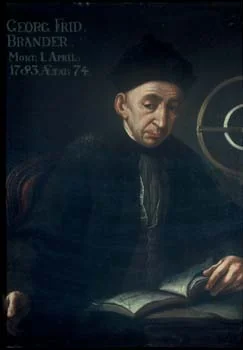
Image from Wikipedia
Image from Wikipedia
Georg Friedrich Brander – The Master of Precision in the Age of Enlightenment
A Pioneer of Fine Mechanics Between Science, Craftsmanship, and European Reputation
Georg Friedrich Brander is among the great names of European instrument making in the 18th century. Born on November 28, 1713, in Regensburg and died on April 1, 1783, in Augsburg, he shaped an era in which scientific accuracy and craftsmanship excellence were inextricably linked as a precision mechanic, instrument maker, and mathematician. His work represents the connection between technical innovation, aesthetic quality, and practical applicability. ([de.wikipedia.org](https://de.wikipedia.org/wiki/Georg_Friedrich_Brander?utm_source=openai))
Brander became particularly known for scientific precision instruments supplied to courts, academies, and research institutions throughout Europe. His instruments were regarded as exceptionally well-crafted and set standards in optical, geodetic, and physical measurement technology. Today, his life's work appears not only as a chapter in the history of technology but also as an example of the cultural dynamism of the Enlightenment, where instruments became tools for thought. ([de.wikipedia.org](https://de.wikipedia.org/wiki/Georg_Friedrich_Brander?utm_source=openai))
Early Years: Regensburg, Altdorf, and the Formative Power of Science
Brander came from a cultured and craft-oriented environment. His father was a pharmacist with roots in Nuremberg, and his mother came from a family of goldsmiths in Regensburg. He showed an early interest in mechanics, but initially, he was to complete an apprenticeship as a merchant in Nuremberg. It was only after his father's death that he turned to science and began studying mathematics and physics at the University of Altdorf under Johann Gabriel Doppelmayr in 1731. ([de.wikipedia.org](https://de.wikipedia.org/wiki/Georg_Friedrich_Brander?utm_source=openai))
This education was crucial for his later career. In Altdorf, mathematical theory, physical thinking, and precise observation of nature combined with a practical scientific culture. Brander learned the mindset that characterized his later instruments: clear construction, precise scaling, reliable operability, and a deep understanding of the needs of astronomers, surveyors, and natural scientists. ([de.wikipedia.org](https://de.wikipedia.org/wiki/Georg_Friedrich_Brander?utm_source=openai))
The Breakthrough in Augsburg: Workshop, Reputation, and European Demand
In 1734, Brander arrived in Augsburg and established a craft business from which a widely respected workshop emerged. His production included mathematical and optical devices, as well as physical, geodetic, and astronomical instruments. Under his hand, Augsburg became a center of fine mechanics, and Brander's workshop brought new life to the art of instrument making in the city on the Lech. ([de.wikipedia.org](https://de.wikipedia.org/wiki/Georg_Friedrich_Brander?utm_source=openai))
As early as 1737, he produced the first reflecting telescope in Germany. This step marks a significant moment in the history of German instrument technology, as it demonstrated Brander's ability to not only adopt international developments but also to productively advance them. His devices were of such high quality that they could compete with English products, and his clientele soon extended far beyond Swabia. ([de.wikipedia.org](https://de.wikipedia.org/wiki/Georg_Friedrich_Brander?utm_source=openai))
Brander's clients included European courts, academies, and scholars. Particularly noteworthy is the role of his workshop as a supplier of scientific instruments for the Electoral Bavarian Academy of Sciences, which he helped establish in 1759. Historical records indicate that around 150 instruments were produced from his workshop, a number that impressively showcases the productivity and renown of his manufacturing. ([de.wikipedia.org](https://de.wikipedia.org/wiki/Georg_Friedrich_Brander?utm_source=openai))
Innovation from the Workbench: Telescopes, Measurement Tables, and New Precision
Brander's inventions reflect the central role that measurement accuracy played in the 18th century. Particularly important were a measurement table with a telescope, a glass micrometer, and a fine plate as well as the so-called disc instrument, from which the theodolite later developed. With this, Brander contributed to the development of practical geodesy and the refinement of surveying techniques. ([de.wikipedia.org](https://de.wikipedia.org/wiki/Georg_Friedrich_Brander?utm_source=openai))
Around 1775, he developed the star finder, a telescope that was coupled with a star map. The instrument not only facilitated the locating of celestial bodies for professionals but also for educated laypersons, connecting scientific function with didactic benefit. The German Museum describes the design as a means to make stars, the moon, and planets particularly accessible; the LEO-BW documentation categorizes the star finder as a combination of telescope, celestial globe, astrolabe, and armillary sphere. ([digital.deutsches-museum.de](https://digital.deutsches-museum.de/projekte/gruendungssammlung/detail/2049/?count=1&hits=9&objectWorkTypes_facets=Kompass&q=%2A&query=%7B%27simple%27%3A+u%27%2A%27%7D&start=0&utm_source=openai))
Towards the end of his career, Brander developed a coincidence range finder in 1778 that could determine distances by overlapping two mirrored images. Barometers, thermometers, and camera obscuras were also part of his repertoire. The diversity of these instruments showcases an inventor who was not limited to a single segment but catered to the full range of scientific observation. ([de.wikipedia.org](https://de.wikipedia.org/wiki/Georg_Friedrich_Brander?utm_source=openai))
Writings, Scientific Culture, and the Will for Clarity
Brander was not only a practitioner but also an author of technical writings. His publications dealt with microscopes, thermometers, the universal measuring table, air pumps, magnetic instruments, and other devices. Characteristic of his work was his ambition to explain the operation of his instruments in a comprehensible manner. This connection between construction and instruction made his work particularly valuable for the scientific culture of the Enlightenment. ([de.wikipedia.org](https://de.wikipedia.org/wiki/Georg_Friedrich_Brander?utm_source=openai))
This text production is more than just accompanying material. It shows an early form of technical communication, where knowledge does not reside solely in the workpiece but in the precise transmission of its use. Thus, Brander's devices were not only high-quality measurement objects but also didactic tools of an experimental culture that relied on traceability, reproducibility, and applicability. ([de.wikipedia.org](https://de.wikipedia.org/wiki/Georg_Friedrich_Brander?utm_source=openai))
Reception, Recognition, and European Significance
Brander's reputation extended far beyond Augsburg. He supplied to European courts and academies, received the Golden Medal from the Danish Academy in 1779, and was recognized as a member of the Munich Academy of Sciences. The German Biography describes his work as stylistically influential for instruments that were especially carefully and beautifully crafted. His instruments were among the best of their time and found wide use in scientific practice. ([deutsche-biographie.de](https://www.deutsche-biographie.de/sfz5528.html?utm_source=openai))
Renowned scholars also appreciated his precision. Among those documented is the admiration from Johann Heinrich Lambert and Alessandro Volta, who explicitly praised Brander as "famoso." Such indications show that Brander's work was not only present in workshop catalogs but also in the international scholarly community. His instruments became objects of trust in an era when measurement accuracy became the foundation of scientific knowledge. ([de.wikipedia.org](https://de.wikipedia.org/wiki/Georg_Friedrich_Brander?utm_source=openai))
Workshop, Succession, and Lasting Influence
Around 1760, Christoph Caspar Höschel entered Brander's service and became a partner in the business after marrying Brander's daughter, Barbara Euphrosina, in 1775. After Brander's death in 1783, Höschel continued the workshop and maintained the reputation of fine mechanics in Augsburg for some time at a high level. This continuity shows that Brander was not only a solitary genius but left behind a productive workshop culture. ([de.wikipedia.org](https://de.wikipedia.org/wiki/Christoph_Caspar_H%C3%B6schel?utm_source=openai))
Today, the German Museum in Munich preserves an extensive collection of his instruments, while Brander's name remains present in Augsburg through Branderstraße. The star finder and other originals in museum collections document how far-reaching his legacy extends to the present day. Thus, Brander's influence lies not only in individual inventions but in the establishment of a standard for scientific instruments that resonates deeply into modern measurement technology. ([digital.deutsches-museum.de](https://digital.deutsches-museum.de/projekte/gruendungssammlung/detail/2049/?count=1&hits=9&objectWorkTypes_facets=Kompass&q=%2A&query=%7B%27simple%27%3A+u%27%2A%27%7D&start=0&utm_source=openai))
Cultural Significance: A Craftsman as a Designer of the Enlightenment
Georg Friedrich Brander embodies the rare connection of craftsmanship, science, and cultural significance. His workshop stood at the intersection of laboratory, observatory, and studio. At a time when nature was made readable with instruments, he was one of those who made this readability possible in the first place. ([de.wikipedia.org](https://de.wikipedia.org/wiki/Georg_Friedrich_Brander?utm_source=openai))
His life's work makes visible how closely technical innovation and cultural progress are interlinked. Brander created not only devices but a precise language of observation. Anyone who examines his instruments recognizes the ideal of the Enlightenment: to measure, organize, explain, and make the world accessible. ([de.wikipedia.org](https://de.wikipedia.org/wiki/Georg_Friedrich_Brander?utm_source=openai))
Conclusion: Why Georg Friedrich Brander Continues to Fascinate Today
Georg Friedrich Brander remains intriguing because he embodies the profile of a true pioneer: a learned practitioner, innovative mechanic, precise constructor, and important networker of European scientific culture. His devices combined technical sophistication with practical utility, making him one of the most significant instrument makers of the 18th century. Anyone interested in the history of technology, the Enlightenment, and the development of modern measurement methods encounters a key figure in Brander. ([de.wikipedia.org](https://de.wikipedia.org/wiki/Georg_Friedrich_Brander?utm_source=openai))
His name represents the art of shaping knowledge. For this reason, it is worthwhile to revisit his work time and again: as a historical testament, as a technical masterpiece, and as a cultural heritage that makes the beginnings of modern scientific precision visible. Experiencing his instruments in the museum helps one understand how lively the Enlightenment can be. ([collection.sciencemuseumgroup.org.uk](https://collection.sciencemuseumgroup.org.uk/people/cp38638/georg-friedrich-brander?utm_source=openai))
Official Channels of Georg Friedrich Brander:
- Instagram: no official profile found
- Facebook: no official profile found
- YouTube: no official profile found
- Spotify: no official profile found
- TikTok: no official profile found