
Maximilianstraße 46, Augsburg
Maximilianstraße 46, 86150 Augsburg, Germany
Schaezlerpalais | Opening Hours & Current Exhibition
The Schaezlerpalais is one of the great cultural treasures of Augsburg and at the same time a place where architecture, residential culture, painting, and music meet in a very concentrated way. Located directly at the Hercules Fountain on Maximilianstraße, it is considered Augsburg's most significant and best-preserved private residential and commercial building of the 18th century. Upon entering the house, visitors experience not only a Rococo palace with impressive sequences of rooms but also a lively museum featuring the German Baroque Gallery, the Steiner Collection, changing special exhibitions, the famous Rococo Festsaal, and a garden that appears surprisingly tranquil in the midst of the city center. This combination of historical authenticity and contemporary use makes the Schaezlerpalais particularly attractive to visitors. It is both a destination for art lovers and a place for people who wish to learn about Augsburg's history in a particularly elegant form. ([kunstsammlungen-museen.augsburg.de](https://kunstsammlungen-museen.augsburg.de/schaezlerpalais))
Opening Hours, Admission, and Current Exhibition
For planning a visit, the most important information is quickly summarized: The Schaezlerpalais is open from Tuesday to Sunday from 10 AM to 5 PM; it is closed on Mondays. Additionally, it is not possible to visit on Christmas Eve, New Year's Eve, Rose Monday, Shrove Tuesday, and Good Friday. These clear opening hours make travel easy to plan, especially if one wants to combine a walk through Maximilianstraße with a museum visit. The pricing structure is also visitor-friendly, as the permanent exhibition costs 7.00 euros regularly, 5.50 euros reduced, and admission is free for those under 27. Special exhibitions cost 9.00 euros regularly, with discounts and group tickets also available. On Sundays, the permanent exhibition is freely accessible as part of Museum Sunday, making the Schaezlerpalais very interesting for spontaneous visits. ([kunstsammlungen-museen.augsburg.de](https://kunstsammlungen-museen.augsburg.de/besucherinfo/besuch))
Particularly important for current inquiries is the ongoing special exhibition. Until April 12, 2026, the Schaezlerpalais is showcasing the cabinet exhibition The Wealth of Art – Jakob Fugger and His Legacy. The Art Collections and Museums Augsburg present this exhibition in cooperation with the Prince and Count Fugger Foundations on the occasion of the 500th anniversary of Jakob Fugger the Rich's death. According to the official announcement, the exhibition consists of three thematic blocks in three representative rooms on the second floor of the Schaezlerpalais. It connects the art and cultural history of the Fuggers with Venetian masters such as Canaletto, Veronese, and Tiepolo, as well as with paintings by Hans Maler and Albrecht Dürer that have not been shown for a long time. This is complemented by jewelry, crafts, and graphics from the possession and environment of the Fuggers. This mixture of great trading history, patronage, and representative art explains why the search terms current exhibition, Goya, Fugger, and Baroque Gallery frequently appear in connection with the house. ([kunstsammlungen-museen.augsburg.de](https://kunstsammlungen-museen.augsburg.de/fugger?utm_source=openai))
Rococo Festsaal, German Baroque Gallery, and the Magnificent Rooms
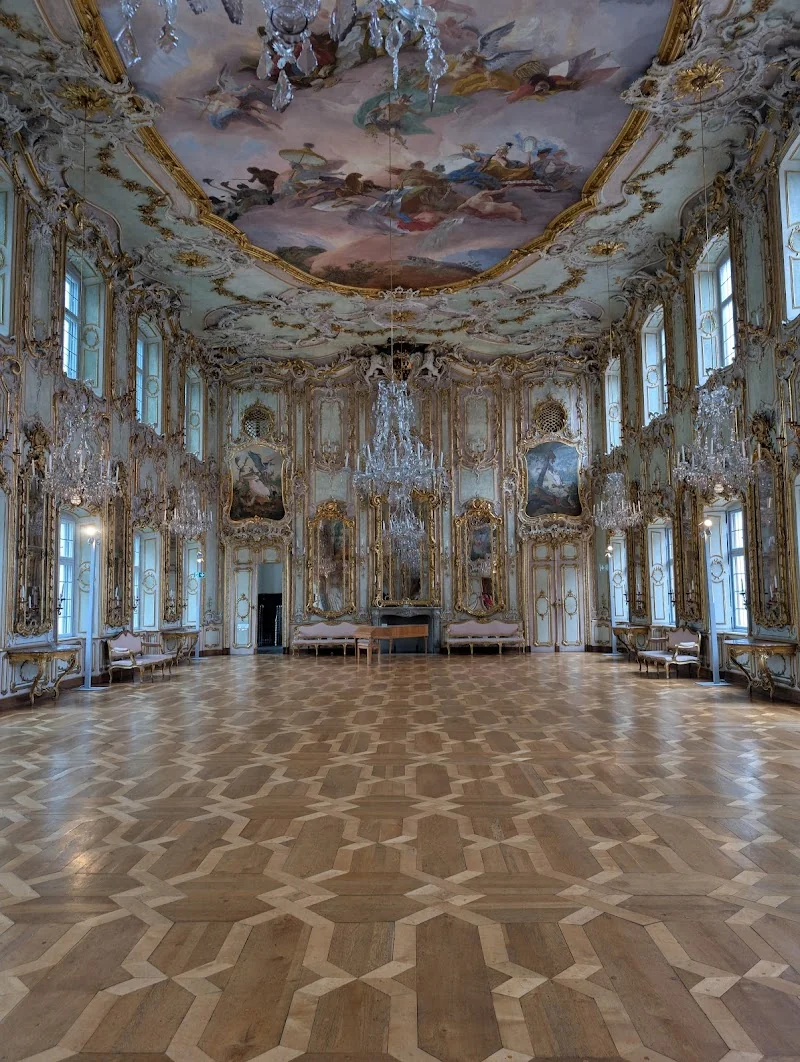
The most famous room in the house is the Rococo Festsaal. It forms the centerpiece of the palace built between 1765 and 1770 and still conveys the feeling of an almost completely preserved total work of art. The official description emphasizes that a large part of the surfaces is original, making the hall a unique document of South German Rococo. The ceiling fresco was created by Gregorio Guglielmi in 1767; it depicts an allegory of trade between the continents, a theme that can be understood not only decoratively but also programmatically. Mirrors, walls, and furniture blend into the grand stucco architecture of the brothers Franz-Xaver and Simpert Feichtmayr, creating an extremely dense spatial effect. The Festsaal was ceremoniously inaugurated in 1770, and to this day, this room explains why the Schaezlerpalais enjoys a special reputation in Augsburg not only as a museum but also as a cultural and event venue. ([kunstsammlungen-museen.augsburg.de](https://kunstsammlungen-museen.augsburg.de/schaezlerpalais))
Immediately in front of it is a more than 100-meter-long baroque sequence of rooms, the enfilade, which leads through the magnificent rooms of the first floor. Here is the German Baroque Gallery, which brings together around one hundred masterpieces from the collections of the city of Augsburg and from lenders. The focus is on artists who worked in Augsburg or are closely connected to the city's art development, including Josef Heintz, Matthäus Gundelach, Johann König, Johann Georg Bergmüller, Johann Evangelist Holzer, and Matthäus Günther. The gallery thus tells not only of individual paintings but of Augsburg as a style-defining center of art in the 17th and 18th centuries. The official presentation emphasizes that the German Rococo was once referred to as Augsburg taste. This is precisely what makes the museum visit so exciting: one does not simply see a loose collection here, but a deliberately staged concentration of baroque and rococo painting that impressively makes the art-historical significance of the city visible. ([kunstsammlungen-museen.augsburg.de](https://kunstsammlungen-museen.augsburg.de/schaezlerpalais))
History of the Schaezlerpalais from Bürgerresidenz to Museum
The history of the Schaezlerpalais begins at a place of even older significance. The current building stands on the site of a late medieval patrician house, where the bourgeois Philippine Welser was born, who later became the wife of Archduke Ferdinand of Austria. In 1764, the Augsburg banker Benedikt Adam Liebert von Liebenhofen acquired the property, had the older building demolished, and from 1765 built a new residential and commercial building. For the planning, he enlisted the Munich court architect Karl Albert von Lespilliez; the execution was taken over by the local master mason Johann Gottfried Stumpe. With this combination of regional craftsmanship and courtly design quality, a palace was created that was considered the most brilliant Augsburg townhouse of the 18th century in its time. After Liebert's death, the house passed into the possession of his son-in-law Johann Lorenz Baron von Schaezler, whose name has remained to this day. ([kunstsammlungen-museen.augsburg.de](https://kunstsammlungen-museen.augsburg.de/schaezlerpalais))
The usage history of the building is as remarkable as its creation. Until 1958, the palace remained in family ownership and was then gifted to the city of Augsburg by Liebert's descendants. As early as December 1945, it served museum purposes, initially with special exhibitions, later from 1951 with presentations of the municipal collection. Since 1970, the German Baroque Gallery has been located here, and during the renovation of the entire building complex from 2004 to 2006, the concept was revised. This museum development shows how well the house mediates between monument preservation and contemporary use. It is not just a preserved object, but a place that has been reinterpreted time and again for decades. It is precisely in this historical continuity that part of its special charisma lies: the Schaezlerpalais remains, on the one hand, an authentic testimony to Augsburg's city history, and on the other hand, a vibrant space for art education, research, and public culture. ([kunstsammlungen-museen.augsburg.de](https://kunstsammlungen-museen.augsburg.de/schaezlerpalais))
Steiner Collection, Haberstock Foundation, and Special Exhibitions
In addition to the Baroque Gallery, the diversity of other collection areas primarily shapes the profile of the house. On the ground floor, the Steiner Collection can be seen, an extensive collection of reverse glass paintings from the 18th century. Augsburg was one of the centers of Europe for this technique, and the works in the Steiner Cabinet show religious, allegorical, landscape, and mythological motifs in a form that mediates between crafts and fine arts. Access is via the museum café, which gives the area a pleasantly open and low-threshold effect. Also important is the Haberstock Foundation, whose approximately 40 masterpieces of European painting are presented in the Schaezlerpalais. Here, visitors encounter works by Paolo Veronese, Giovanni Battista Tiepolo, Anthonis van Dyck, Jacob Ruisdael, and Lucas Cranach the Elder. These focuses show that the house goes far beyond a classic city palace presentation. It connects Augsburg's local art history with a view of European contexts. ([kunstsammlungen-museen.augsburg.de](https://kunstsammlungen-museen.augsburg.de/schaezlerpalais))
The special exhibitions also contribute to the house's special appeal. They usually take place on the second floor and make the Schaezlerpalais a place that can depict several epochs and themes simultaneously. This is demonstrated by the current Fugger exhibition as well as previous and accompanying presentations. In recent months and years, the house has shown topics related to Goya and Dalí, painting, graphics, and music, as well as Augsburg's art and cultural history. The Art Collections and Museums Augsburg also point out in their magazine guided tours and short tours that take place on Sundays. For visitors, this is an important note because the place thus functions not only as a quiet museum but as a program house with changing perspectives. Therefore, it is always worthwhile to take a look at the current thematic program for inquiries about current exhibitions, Goya, guided tours, or tickets, as the Schaezlerpalais regularly works with new content without losing its historical identity. ([kunstsammlungen-museen.augsburg.de](https://kunstsammlungen-museen.augsburg.de/schaezlerpalais-termine/seht-wie-wuerdevoll-140326?utm_source=openai))
Rococo Garden, Directions, and Parking in Augsburg City Center
The Rococo Garden is one of the most pleasant parts of the entire ensemble. It was designed in 2005 based on historical findings and once again forms a typical private garden of a city palace. On the south side of the building, it extends as a nearly square four-field layout with a central fountain. This is not only beautiful to look at but also urbanistically remarkable, as the building and garden are aligned as an architectural unit. The current arcade was probably originally used as an orangery and greenhouse. Important for many visitors is also: The garden is open to people who do not visit the museum at all. This makes it a quiet, freely accessible place in the city center where one can take a short breath between the representative facades of Maximilianstraße. For the search query schaezlerpalais garden, this combination of historical reconstruction and free access is central. ([kunstsammlungen-museen.augsburg.de](https://kunstsammlungen-museen.augsburg.de/schaezlerpalais))
When traveling, the official sites clearly recommend public transport, bicycles, or e-scooters due to the limited parking options in the city center. In the free city zone, one can travel from the main train station without a ticket almost directly to the door of some museums, including the Schaezlerpalais. For the house itself, practical routes include tram and bus lines to Königsplatz with a short walk through Katharinengasse, as well as tram lines 1 and 2 and bus lines 22 and 32 to Moritzplatz, from where it is only a few minutes through Maximilianstraße. However, those who still come by car can find current parking information in the city's parking service, which offers real-time overviews of parking garages and park-and-ride lots. This is particularly relevant for the day of the visit because a city center like Augsburg is easily accessible but not designed for spontaneous parking searches. Therefore, it is advisable to plan the journey in advance and to rely more on public transport or P+R on heavily frequented days. ([kunstsammlungen-museen.augsburg.de](https://kunstsammlungen-museen.augsburg.de/anreise))
Guided Tours, Concerts, and Visitor Tips for the Schaezlerpalais
Those who want to experience the Schaezlerpalais not just as a quiet museum but as a vibrant cultural venue will find an astonishingly dense event program there. The official event pages regularly show guided tours through special exhibitions such as The Wealth of Art – Jakob Fugger and His Legacy, as well as thematic tours of individual aspects of the program. Furthermore, the Rococo Festsaal plays an important role as a concert venue. Evenings with baroque chamber music, Mozart-related programs, or historically informed ensembles take place here. Tickets are often sold at the ticket office of the Schaezlerpalais, at the tourist information at Rathausplatz, or via the online ticket portal Reservix; the program ranges from baroque chamber music to Mozart-related evenings. This practice shows that the house is used not only for museum visits but also for evening events with cultural aspirations. For inquiries about schaezlerpalais augsburg concerts or schaezlerpalais guided tours, this is a central aspect because both are very typical for the place. ([kunstsammlungen-museen.augsburg.de](https://kunstsammlungen-museen.augsburg.de/schaezlerpalais-termine/abschiedssinfonie?utm_source=openai))
It is precisely the diversity of the program that makes it appealing. In the official dates, titles such as Farewell Symphony, Romanticism, Piacere musicale, or Mozart's Clavier World appear, emphasizing the focus on historical music and the special acoustic space of the Festsaal. In addition, there are thematic guided tours, for example, about the current Fugger exhibition or earlier Spanish master graphics with Goya and Dalí. For visitors who want to plan their stay well, the connection between the permanent exhibition and the special exhibition is also interesting: with a ticket for the Schaezlerpalais, both the permanent exhibition and the ongoing special presentations are accessible, and on Sundays, free admission is added. A worthwhile visit tip is therefore to plan the museum tour not too briefly. Those who bring enough time can comfortably combine the Baroque Gallery, the Festsaal, the Steiner Collection, the garden, and a current special exhibition in one afternoon. This is where the strength of the Schaezlerpalais lies: it offers not only a beautiful space but a multifaceted experience of art, architecture, history, and atmosphere. ([kunstsammlungen-museen.augsburg.de](https://kunstsammlungen-museen.augsburg.de/schaezlerpalais-termine/piacere-musicale-031025?utm_source=openai))
Why a Visit is Particularly Worthwhile
The Schaezlerpalais is not a museum that one visits only for a single exhibit, even though the Rococo Festsaal undoubtedly ranks among the most impressive rooms in Southern Germany. The real charm lies in the combination of many levels: a historically grown city palace, an exceedingly well-preserved sequence of rooms, a significant Baroque gallery, the Steiner Collection with reverse glass painting, the Haberstock Foundation with European masters, changing special exhibitions, and a garden that offers relaxation in the middle of the city. For visitors to Augsburg, the house is almost a compressed introduction to the art and cultural history of the city. For locals, it is a place where the familiar can be rediscovered time and again. The official self-presentation clearly emphasizes this special position by describing the palace as Augsburg's most significant and best-preserved private residential and commercial building of the 18th century. So, for those looking for a place that not only displays history but makes it spatially tangible, they will find one of the city's strongest addresses here. ([kunstsammlungen-museen.augsburg.de](https://kunstsammlungen-museen.augsburg.de/schaezlerpalais))
Also, for search intentions related to opening hours, admission, prices, current exhibition, garden, parking, guided tours, and concerts, the Schaezlerpalais is ideal because it actually covers all these topics and does not just list them as keywords. The mix of international art, regional history, and a lively event house makes the visit varied and planable at the same time. Those who primarily want to see the Festsaal will find just as much as those who want to visit an exhibition, seek a quiet garden, or learn about Augsburg's baroque heritage. The house thus proves that a historic palace does not have to appear dusty, but can be perceived as very modern with well-curated content, clear visitor information, and a strong architectural identity. For later travel planning, it is advisable to check the current dates before the visit, as guided tours and concerts particularly complement the regular museum visit in a very attractive way. Thus, a simple stop on Maximilianstraße quickly becomes a cultural highlight with a lasting impression. ([kunstsammlungen-museen.augsburg.de](https://kunstsammlungen-museen.augsburg.de/besucherinfo/besuch))
Sources:
- Art Collections & Museums Augsburg – Schaezlerpalais ([kunstsammlungen-museen.augsburg.de](https://kunstsammlungen-museen.augsburg.de/schaezlerpalais))
- Art Collections & Museums Augsburg – Your Visit ([kunstsammlungen-museen.augsburg.de](https://kunstsammlungen-museen.augsburg.de/besucherinfo/besuch))
- Art Collections & Museums Augsburg – Directions ([kunstsammlungen-museen.augsburg.de](https://kunstsammlungen-museen.augsburg.de/anreise))
- Art Collections & Museums Augsburg – Wealth of Art – Jakob Fugger and His Legacy ([kunstsammlungen-museen.augsburg.de](https://kunstsammlungen-museen.augsburg.de/fugger?utm_source=openai))
- Art Collections & Museums Augsburg – Dates and Concerts at the Schaezlerpalais ([kunstsammlungen-museen.augsburg.de](https://kunstsammlungen-museen.augsburg.de/schaezlerpalais-termine/abschiedssinfonie?utm_source=openai))
Show moreShow less
Schaezlerpalais | Opening Hours & Current Exhibition
The Schaezlerpalais is one of the great cultural treasures of Augsburg and at the same time a place where architecture, residential culture, painting, and music meet in a very concentrated way. Located directly at the Hercules Fountain on Maximilianstraße, it is considered Augsburg's most significant and best-preserved private residential and commercial building of the 18th century. Upon entering the house, visitors experience not only a Rococo palace with impressive sequences of rooms but also a lively museum featuring the German Baroque Gallery, the Steiner Collection, changing special exhibitions, the famous Rococo Festsaal, and a garden that appears surprisingly tranquil in the midst of the city center. This combination of historical authenticity and contemporary use makes the Schaezlerpalais particularly attractive to visitors. It is both a destination for art lovers and a place for people who wish to learn about Augsburg's history in a particularly elegant form. ([kunstsammlungen-museen.augsburg.de](https://kunstsammlungen-museen.augsburg.de/schaezlerpalais))
Opening Hours, Admission, and Current Exhibition
For planning a visit, the most important information is quickly summarized: The Schaezlerpalais is open from Tuesday to Sunday from 10 AM to 5 PM; it is closed on Mondays. Additionally, it is not possible to visit on Christmas Eve, New Year's Eve, Rose Monday, Shrove Tuesday, and Good Friday. These clear opening hours make travel easy to plan, especially if one wants to combine a walk through Maximilianstraße with a museum visit. The pricing structure is also visitor-friendly, as the permanent exhibition costs 7.00 euros regularly, 5.50 euros reduced, and admission is free for those under 27. Special exhibitions cost 9.00 euros regularly, with discounts and group tickets also available. On Sundays, the permanent exhibition is freely accessible as part of Museum Sunday, making the Schaezlerpalais very interesting for spontaneous visits. ([kunstsammlungen-museen.augsburg.de](https://kunstsammlungen-museen.augsburg.de/besucherinfo/besuch))
Particularly important for current inquiries is the ongoing special exhibition. Until April 12, 2026, the Schaezlerpalais is showcasing the cabinet exhibition The Wealth of Art – Jakob Fugger and His Legacy. The Art Collections and Museums Augsburg present this exhibition in cooperation with the Prince and Count Fugger Foundations on the occasion of the 500th anniversary of Jakob Fugger the Rich's death. According to the official announcement, the exhibition consists of three thematic blocks in three representative rooms on the second floor of the Schaezlerpalais. It connects the art and cultural history of the Fuggers with Venetian masters such as Canaletto, Veronese, and Tiepolo, as well as with paintings by Hans Maler and Albrecht Dürer that have not been shown for a long time. This is complemented by jewelry, crafts, and graphics from the possession and environment of the Fuggers. This mixture of great trading history, patronage, and representative art explains why the search terms current exhibition, Goya, Fugger, and Baroque Gallery frequently appear in connection with the house. ([kunstsammlungen-museen.augsburg.de](https://kunstsammlungen-museen.augsburg.de/fugger?utm_source=openai))
Rococo Festsaal, German Baroque Gallery, and the Magnificent Rooms
The most famous room in the house is the Rococo Festsaal. It forms the centerpiece of the palace built between 1765 and 1770 and still conveys the feeling of an almost completely preserved total work of art. The official description emphasizes that a large part of the surfaces is original, making the hall a unique document of South German Rococo. The ceiling fresco was created by Gregorio Guglielmi in 1767; it depicts an allegory of trade between the continents, a theme that can be understood not only decoratively but also programmatically. Mirrors, walls, and furniture blend into the grand stucco architecture of the brothers Franz-Xaver and Simpert Feichtmayr, creating an extremely dense spatial effect. The Festsaal was ceremoniously inaugurated in 1770, and to this day, this room explains why the Schaezlerpalais enjoys a special reputation in Augsburg not only as a museum but also as a cultural and event venue. ([kunstsammlungen-museen.augsburg.de](https://kunstsammlungen-museen.augsburg.de/schaezlerpalais))
Immediately in front of it is a more than 100-meter-long baroque sequence of rooms, the enfilade, which leads through the magnificent rooms of the first floor. Here is the German Baroque Gallery, which brings together around one hundred masterpieces from the collections of the city of Augsburg and from lenders. The focus is on artists who worked in Augsburg or are closely connected to the city's art development, including Josef Heintz, Matthäus Gundelach, Johann König, Johann Georg Bergmüller, Johann Evangelist Holzer, and Matthäus Günther. The gallery thus tells not only of individual paintings but of Augsburg as a style-defining center of art in the 17th and 18th centuries. The official presentation emphasizes that the German Rococo was once referred to as Augsburg taste. This is precisely what makes the museum visit so exciting: one does not simply see a loose collection here, but a deliberately staged concentration of baroque and rococo painting that impressively makes the art-historical significance of the city visible. ([kunstsammlungen-museen.augsburg.de](https://kunstsammlungen-museen.augsburg.de/schaezlerpalais))
History of the Schaezlerpalais from Bürgerresidenz to Museum
The history of the Schaezlerpalais begins at a place of even older significance. The current building stands on the site of a late medieval patrician house, where the bourgeois Philippine Welser was born, who later became the wife of Archduke Ferdinand of Austria. In 1764, the Augsburg banker Benedikt Adam Liebert von Liebenhofen acquired the property, had the older building demolished, and from 1765 built a new residential and commercial building. For the planning, he enlisted the Munich court architect Karl Albert von Lespilliez; the execution was taken over by the local master mason Johann Gottfried Stumpe. With this combination of regional craftsmanship and courtly design quality, a palace was created that was considered the most brilliant Augsburg townhouse of the 18th century in its time. After Liebert's death, the house passed into the possession of his son-in-law Johann Lorenz Baron von Schaezler, whose name has remained to this day. ([kunstsammlungen-museen.augsburg.de](https://kunstsammlungen-museen.augsburg.de/schaezlerpalais))
The usage history of the building is as remarkable as its creation. Until 1958, the palace remained in family ownership and was then gifted to the city of Augsburg by Liebert's descendants. As early as December 1945, it served museum purposes, initially with special exhibitions, later from 1951 with presentations of the municipal collection. Since 1970, the German Baroque Gallery has been located here, and during the renovation of the entire building complex from 2004 to 2006, the concept was revised. This museum development shows how well the house mediates between monument preservation and contemporary use. It is not just a preserved object, but a place that has been reinterpreted time and again for decades. It is precisely in this historical continuity that part of its special charisma lies: the Schaezlerpalais remains, on the one hand, an authentic testimony to Augsburg's city history, and on the other hand, a vibrant space for art education, research, and public culture. ([kunstsammlungen-museen.augsburg.de](https://kunstsammlungen-museen.augsburg.de/schaezlerpalais))
Steiner Collection, Haberstock Foundation, and Special Exhibitions
In addition to the Baroque Gallery, the diversity of other collection areas primarily shapes the profile of the house. On the ground floor, the Steiner Collection can be seen, an extensive collection of reverse glass paintings from the 18th century. Augsburg was one of the centers of Europe for this technique, and the works in the Steiner Cabinet show religious, allegorical, landscape, and mythological motifs in a form that mediates between crafts and fine arts. Access is via the museum café, which gives the area a pleasantly open and low-threshold effect. Also important is the Haberstock Foundation, whose approximately 40 masterpieces of European painting are presented in the Schaezlerpalais. Here, visitors encounter works by Paolo Veronese, Giovanni Battista Tiepolo, Anthonis van Dyck, Jacob Ruisdael, and Lucas Cranach the Elder. These focuses show that the house goes far beyond a classic city palace presentation. It connects Augsburg's local art history with a view of European contexts. ([kunstsammlungen-museen.augsburg.de](https://kunstsammlungen-museen.augsburg.de/schaezlerpalais))
The special exhibitions also contribute to the house's special appeal. They usually take place on the second floor and make the Schaezlerpalais a place that can depict several epochs and themes simultaneously. This is demonstrated by the current Fugger exhibition as well as previous and accompanying presentations. In recent months and years, the house has shown topics related to Goya and Dalí, painting, graphics, and music, as well as Augsburg's art and cultural history. The Art Collections and Museums Augsburg also point out in their magazine guided tours and short tours that take place on Sundays. For visitors, this is an important note because the place thus functions not only as a quiet museum but as a program house with changing perspectives. Therefore, it is always worthwhile to take a look at the current thematic program for inquiries about current exhibitions, Goya, guided tours, or tickets, as the Schaezlerpalais regularly works with new content without losing its historical identity. ([kunstsammlungen-museen.augsburg.de](https://kunstsammlungen-museen.augsburg.de/schaezlerpalais-termine/seht-wie-wuerdevoll-140326?utm_source=openai))
Rococo Garden, Directions, and Parking in Augsburg City Center
The Rococo Garden is one of the most pleasant parts of the entire ensemble. It was designed in 2005 based on historical findings and once again forms a typical private garden of a city palace. On the south side of the building, it extends as a nearly square four-field layout with a central fountain. This is not only beautiful to look at but also urbanistically remarkable, as the building and garden are aligned as an architectural unit. The current arcade was probably originally used as an orangery and greenhouse. Important for many visitors is also: The garden is open to people who do not visit the museum at all. This makes it a quiet, freely accessible place in the city center where one can take a short breath between the representative facades of Maximilianstraße. For the search query schaezlerpalais garden, this combination of historical reconstruction and free access is central. ([kunstsammlungen-museen.augsburg.de](https://kunstsammlungen-museen.augsburg.de/schaezlerpalais))
When traveling, the official sites clearly recommend public transport, bicycles, or e-scooters due to the limited parking options in the city center. In the free city zone, one can travel from the main train station without a ticket almost directly to the door of some museums, including the Schaezlerpalais. For the house itself, practical routes include tram and bus lines to Königsplatz with a short walk through Katharinengasse, as well as tram lines 1 and 2 and bus lines 22 and 32 to Moritzplatz, from where it is only a few minutes through Maximilianstraße. However, those who still come by car can find current parking information in the city's parking service, which offers real-time overviews of parking garages and park-and-ride lots. This is particularly relevant for the day of the visit because a city center like Augsburg is easily accessible but not designed for spontaneous parking searches. Therefore, it is advisable to plan the journey in advance and to rely more on public transport or P+R on heavily frequented days. ([kunstsammlungen-museen.augsburg.de](https://kunstsammlungen-museen.augsburg.de/anreise))
Guided Tours, Concerts, and Visitor Tips for the Schaezlerpalais
Those who want to experience the Schaezlerpalais not just as a quiet museum but as a vibrant cultural venue will find an astonishingly dense event program there. The official event pages regularly show guided tours through special exhibitions such as The Wealth of Art – Jakob Fugger and His Legacy, as well as thematic tours of individual aspects of the program. Furthermore, the Rococo Festsaal plays an important role as a concert venue. Evenings with baroque chamber music, Mozart-related programs, or historically informed ensembles take place here. Tickets are often sold at the ticket office of the Schaezlerpalais, at the tourist information at Rathausplatz, or via the online ticket portal Reservix; the program ranges from baroque chamber music to Mozart-related evenings. This practice shows that the house is used not only for museum visits but also for evening events with cultural aspirations. For inquiries about schaezlerpalais augsburg concerts or schaezlerpalais guided tours, this is a central aspect because both are very typical for the place. ([kunstsammlungen-museen.augsburg.de](https://kunstsammlungen-museen.augsburg.de/schaezlerpalais-termine/abschiedssinfonie?utm_source=openai))
It is precisely the diversity of the program that makes it appealing. In the official dates, titles such as Farewell Symphony, Romanticism, Piacere musicale, or Mozart's Clavier World appear, emphasizing the focus on historical music and the special acoustic space of the Festsaal. In addition, there are thematic guided tours, for example, about the current Fugger exhibition or earlier Spanish master graphics with Goya and Dalí. For visitors who want to plan their stay well, the connection between the permanent exhibition and the special exhibition is also interesting: with a ticket for the Schaezlerpalais, both the permanent exhibition and the ongoing special presentations are accessible, and on Sundays, free admission is added. A worthwhile visit tip is therefore to plan the museum tour not too briefly. Those who bring enough time can comfortably combine the Baroque Gallery, the Festsaal, the Steiner Collection, the garden, and a current special exhibition in one afternoon. This is where the strength of the Schaezlerpalais lies: it offers not only a beautiful space but a multifaceted experience of art, architecture, history, and atmosphere. ([kunstsammlungen-museen.augsburg.de](https://kunstsammlungen-museen.augsburg.de/schaezlerpalais-termine/piacere-musicale-031025?utm_source=openai))
Why a Visit is Particularly Worthwhile
The Schaezlerpalais is not a museum that one visits only for a single exhibit, even though the Rococo Festsaal undoubtedly ranks among the most impressive rooms in Southern Germany. The real charm lies in the combination of many levels: a historically grown city palace, an exceedingly well-preserved sequence of rooms, a significant Baroque gallery, the Steiner Collection with reverse glass painting, the Haberstock Foundation with European masters, changing special exhibitions, and a garden that offers relaxation in the middle of the city. For visitors to Augsburg, the house is almost a compressed introduction to the art and cultural history of the city. For locals, it is a place where the familiar can be rediscovered time and again. The official self-presentation clearly emphasizes this special position by describing the palace as Augsburg's most significant and best-preserved private residential and commercial building of the 18th century. So, for those looking for a place that not only displays history but makes it spatially tangible, they will find one of the city's strongest addresses here. ([kunstsammlungen-museen.augsburg.de](https://kunstsammlungen-museen.augsburg.de/schaezlerpalais))
Also, for search intentions related to opening hours, admission, prices, current exhibition, garden, parking, guided tours, and concerts, the Schaezlerpalais is ideal because it actually covers all these topics and does not just list them as keywords. The mix of international art, regional history, and a lively event house makes the visit varied and planable at the same time. Those who primarily want to see the Festsaal will find just as much as those who want to visit an exhibition, seek a quiet garden, or learn about Augsburg's baroque heritage. The house thus proves that a historic palace does not have to appear dusty, but can be perceived as very modern with well-curated content, clear visitor information, and a strong architectural identity. For later travel planning, it is advisable to check the current dates before the visit, as guided tours and concerts particularly complement the regular museum visit in a very attractive way. Thus, a simple stop on Maximilianstraße quickly becomes a cultural highlight with a lasting impression. ([kunstsammlungen-museen.augsburg.de](https://kunstsammlungen-museen.augsburg.de/besucherinfo/besuch))
Sources:
- Art Collections & Museums Augsburg – Schaezlerpalais ([kunstsammlungen-museen.augsburg.de](https://kunstsammlungen-museen.augsburg.de/schaezlerpalais))
- Art Collections & Museums Augsburg – Your Visit ([kunstsammlungen-museen.augsburg.de](https://kunstsammlungen-museen.augsburg.de/besucherinfo/besuch))
- Art Collections & Museums Augsburg – Directions ([kunstsammlungen-museen.augsburg.de](https://kunstsammlungen-museen.augsburg.de/anreise))
- Art Collections & Museums Augsburg – Wealth of Art – Jakob Fugger and His Legacy ([kunstsammlungen-museen.augsburg.de](https://kunstsammlungen-museen.augsburg.de/fugger?utm_source=openai))
- Art Collections & Museums Augsburg – Dates and Concerts at the Schaezlerpalais ([kunstsammlungen-museen.augsburg.de](https://kunstsammlungen-museen.augsburg.de/schaezlerpalais-termine/abschiedssinfonie?utm_source=openai))
Schaezlerpalais | Opening Hours & Current Exhibition
The Schaezlerpalais is one of the great cultural treasures of Augsburg and at the same time a place where architecture, residential culture, painting, and music meet in a very concentrated way. Located directly at the Hercules Fountain on Maximilianstraße, it is considered Augsburg's most significant and best-preserved private residential and commercial building of the 18th century. Upon entering the house, visitors experience not only a Rococo palace with impressive sequences of rooms but also a lively museum featuring the German Baroque Gallery, the Steiner Collection, changing special exhibitions, the famous Rococo Festsaal, and a garden that appears surprisingly tranquil in the midst of the city center. This combination of historical authenticity and contemporary use makes the Schaezlerpalais particularly attractive to visitors. It is both a destination for art lovers and a place for people who wish to learn about Augsburg's history in a particularly elegant form. ([kunstsammlungen-museen.augsburg.de](https://kunstsammlungen-museen.augsburg.de/schaezlerpalais))
Opening Hours, Admission, and Current Exhibition
For planning a visit, the most important information is quickly summarized: The Schaezlerpalais is open from Tuesday to Sunday from 10 AM to 5 PM; it is closed on Mondays. Additionally, it is not possible to visit on Christmas Eve, New Year's Eve, Rose Monday, Shrove Tuesday, and Good Friday. These clear opening hours make travel easy to plan, especially if one wants to combine a walk through Maximilianstraße with a museum visit. The pricing structure is also visitor-friendly, as the permanent exhibition costs 7.00 euros regularly, 5.50 euros reduced, and admission is free for those under 27. Special exhibitions cost 9.00 euros regularly, with discounts and group tickets also available. On Sundays, the permanent exhibition is freely accessible as part of Museum Sunday, making the Schaezlerpalais very interesting for spontaneous visits. ([kunstsammlungen-museen.augsburg.de](https://kunstsammlungen-museen.augsburg.de/besucherinfo/besuch))
Particularly important for current inquiries is the ongoing special exhibition. Until April 12, 2026, the Schaezlerpalais is showcasing the cabinet exhibition The Wealth of Art – Jakob Fugger and His Legacy. The Art Collections and Museums Augsburg present this exhibition in cooperation with the Prince and Count Fugger Foundations on the occasion of the 500th anniversary of Jakob Fugger the Rich's death. According to the official announcement, the exhibition consists of three thematic blocks in three representative rooms on the second floor of the Schaezlerpalais. It connects the art and cultural history of the Fuggers with Venetian masters such as Canaletto, Veronese, and Tiepolo, as well as with paintings by Hans Maler and Albrecht Dürer that have not been shown for a long time. This is complemented by jewelry, crafts, and graphics from the possession and environment of the Fuggers. This mixture of great trading history, patronage, and representative art explains why the search terms current exhibition, Goya, Fugger, and Baroque Gallery frequently appear in connection with the house. ([kunstsammlungen-museen.augsburg.de](https://kunstsammlungen-museen.augsburg.de/fugger?utm_source=openai))
Rococo Festsaal, German Baroque Gallery, and the Magnificent Rooms
The most famous room in the house is the Rococo Festsaal. It forms the centerpiece of the palace built between 1765 and 1770 and still conveys the feeling of an almost completely preserved total work of art. The official description emphasizes that a large part of the surfaces is original, making the hall a unique document of South German Rococo. The ceiling fresco was created by Gregorio Guglielmi in 1767; it depicts an allegory of trade between the continents, a theme that can be understood not only decoratively but also programmatically. Mirrors, walls, and furniture blend into the grand stucco architecture of the brothers Franz-Xaver and Simpert Feichtmayr, creating an extremely dense spatial effect. The Festsaal was ceremoniously inaugurated in 1770, and to this day, this room explains why the Schaezlerpalais enjoys a special reputation in Augsburg not only as a museum but also as a cultural and event venue. ([kunstsammlungen-museen.augsburg.de](https://kunstsammlungen-museen.augsburg.de/schaezlerpalais))
Immediately in front of it is a more than 100-meter-long baroque sequence of rooms, the enfilade, which leads through the magnificent rooms of the first floor. Here is the German Baroque Gallery, which brings together around one hundred masterpieces from the collections of the city of Augsburg and from lenders. The focus is on artists who worked in Augsburg or are closely connected to the city's art development, including Josef Heintz, Matthäus Gundelach, Johann König, Johann Georg Bergmüller, Johann Evangelist Holzer, and Matthäus Günther. The gallery thus tells not only of individual paintings but of Augsburg as a style-defining center of art in the 17th and 18th centuries. The official presentation emphasizes that the German Rococo was once referred to as Augsburg taste. This is precisely what makes the museum visit so exciting: one does not simply see a loose collection here, but a deliberately staged concentration of baroque and rococo painting that impressively makes the art-historical significance of the city visible. ([kunstsammlungen-museen.augsburg.de](https://kunstsammlungen-museen.augsburg.de/schaezlerpalais))
History of the Schaezlerpalais from Bürgerresidenz to Museum
The history of the Schaezlerpalais begins at a place of even older significance. The current building stands on the site of a late medieval patrician house, where the bourgeois Philippine Welser was born, who later became the wife of Archduke Ferdinand of Austria. In 1764, the Augsburg banker Benedikt Adam Liebert von Liebenhofen acquired the property, had the older building demolished, and from 1765 built a new residential and commercial building. For the planning, he enlisted the Munich court architect Karl Albert von Lespilliez; the execution was taken over by the local master mason Johann Gottfried Stumpe. With this combination of regional craftsmanship and courtly design quality, a palace was created that was considered the most brilliant Augsburg townhouse of the 18th century in its time. After Liebert's death, the house passed into the possession of his son-in-law Johann Lorenz Baron von Schaezler, whose name has remained to this day. ([kunstsammlungen-museen.augsburg.de](https://kunstsammlungen-museen.augsburg.de/schaezlerpalais))
The usage history of the building is as remarkable as its creation. Until 1958, the palace remained in family ownership and was then gifted to the city of Augsburg by Liebert's descendants. As early as December 1945, it served museum purposes, initially with special exhibitions, later from 1951 with presentations of the municipal collection. Since 1970, the German Baroque Gallery has been located here, and during the renovation of the entire building complex from 2004 to 2006, the concept was revised. This museum development shows how well the house mediates between monument preservation and contemporary use. It is not just a preserved object, but a place that has been reinterpreted time and again for decades. It is precisely in this historical continuity that part of its special charisma lies: the Schaezlerpalais remains, on the one hand, an authentic testimony to Augsburg's city history, and on the other hand, a vibrant space for art education, research, and public culture. ([kunstsammlungen-museen.augsburg.de](https://kunstsammlungen-museen.augsburg.de/schaezlerpalais))
Steiner Collection, Haberstock Foundation, and Special Exhibitions
In addition to the Baroque Gallery, the diversity of other collection areas primarily shapes the profile of the house. On the ground floor, the Steiner Collection can be seen, an extensive collection of reverse glass paintings from the 18th century. Augsburg was one of the centers of Europe for this technique, and the works in the Steiner Cabinet show religious, allegorical, landscape, and mythological motifs in a form that mediates between crafts and fine arts. Access is via the museum café, which gives the area a pleasantly open and low-threshold effect. Also important is the Haberstock Foundation, whose approximately 40 masterpieces of European painting are presented in the Schaezlerpalais. Here, visitors encounter works by Paolo Veronese, Giovanni Battista Tiepolo, Anthonis van Dyck, Jacob Ruisdael, and Lucas Cranach the Elder. These focuses show that the house goes far beyond a classic city palace presentation. It connects Augsburg's local art history with a view of European contexts. ([kunstsammlungen-museen.augsburg.de](https://kunstsammlungen-museen.augsburg.de/schaezlerpalais))
The special exhibitions also contribute to the house's special appeal. They usually take place on the second floor and make the Schaezlerpalais a place that can depict several epochs and themes simultaneously. This is demonstrated by the current Fugger exhibition as well as previous and accompanying presentations. In recent months and years, the house has shown topics related to Goya and Dalí, painting, graphics, and music, as well as Augsburg's art and cultural history. The Art Collections and Museums Augsburg also point out in their magazine guided tours and short tours that take place on Sundays. For visitors, this is an important note because the place thus functions not only as a quiet museum but as a program house with changing perspectives. Therefore, it is always worthwhile to take a look at the current thematic program for inquiries about current exhibitions, Goya, guided tours, or tickets, as the Schaezlerpalais regularly works with new content without losing its historical identity. ([kunstsammlungen-museen.augsburg.de](https://kunstsammlungen-museen.augsburg.de/schaezlerpalais-termine/seht-wie-wuerdevoll-140326?utm_source=openai))
Rococo Garden, Directions, and Parking in Augsburg City Center
The Rococo Garden is one of the most pleasant parts of the entire ensemble. It was designed in 2005 based on historical findings and once again forms a typical private garden of a city palace. On the south side of the building, it extends as a nearly square four-field layout with a central fountain. This is not only beautiful to look at but also urbanistically remarkable, as the building and garden are aligned as an architectural unit. The current arcade was probably originally used as an orangery and greenhouse. Important for many visitors is also: The garden is open to people who do not visit the museum at all. This makes it a quiet, freely accessible place in the city center where one can take a short breath between the representative facades of Maximilianstraße. For the search query schaezlerpalais garden, this combination of historical reconstruction and free access is central. ([kunstsammlungen-museen.augsburg.de](https://kunstsammlungen-museen.augsburg.de/schaezlerpalais))
When traveling, the official sites clearly recommend public transport, bicycles, or e-scooters due to the limited parking options in the city center. In the free city zone, one can travel from the main train station without a ticket almost directly to the door of some museums, including the Schaezlerpalais. For the house itself, practical routes include tram and bus lines to Königsplatz with a short walk through Katharinengasse, as well as tram lines 1 and 2 and bus lines 22 and 32 to Moritzplatz, from where it is only a few minutes through Maximilianstraße. However, those who still come by car can find current parking information in the city's parking service, which offers real-time overviews of parking garages and park-and-ride lots. This is particularly relevant for the day of the visit because a city center like Augsburg is easily accessible but not designed for spontaneous parking searches. Therefore, it is advisable to plan the journey in advance and to rely more on public transport or P+R on heavily frequented days. ([kunstsammlungen-museen.augsburg.de](https://kunstsammlungen-museen.augsburg.de/anreise))
Guided Tours, Concerts, and Visitor Tips for the Schaezlerpalais
Those who want to experience the Schaezlerpalais not just as a quiet museum but as a vibrant cultural venue will find an astonishingly dense event program there. The official event pages regularly show guided tours through special exhibitions such as The Wealth of Art – Jakob Fugger and His Legacy, as well as thematic tours of individual aspects of the program. Furthermore, the Rococo Festsaal plays an important role as a concert venue. Evenings with baroque chamber music, Mozart-related programs, or historically informed ensembles take place here. Tickets are often sold at the ticket office of the Schaezlerpalais, at the tourist information at Rathausplatz, or via the online ticket portal Reservix; the program ranges from baroque chamber music to Mozart-related evenings. This practice shows that the house is used not only for museum visits but also for evening events with cultural aspirations. For inquiries about schaezlerpalais augsburg concerts or schaezlerpalais guided tours, this is a central aspect because both are very typical for the place. ([kunstsammlungen-museen.augsburg.de](https://kunstsammlungen-museen.augsburg.de/schaezlerpalais-termine/abschiedssinfonie?utm_source=openai))
It is precisely the diversity of the program that makes it appealing. In the official dates, titles such as Farewell Symphony, Romanticism, Piacere musicale, or Mozart's Clavier World appear, emphasizing the focus on historical music and the special acoustic space of the Festsaal. In addition, there are thematic guided tours, for example, about the current Fugger exhibition or earlier Spanish master graphics with Goya and Dalí. For visitors who want to plan their stay well, the connection between the permanent exhibition and the special exhibition is also interesting: with a ticket for the Schaezlerpalais, both the permanent exhibition and the ongoing special presentations are accessible, and on Sundays, free admission is added. A worthwhile visit tip is therefore to plan the museum tour not too briefly. Those who bring enough time can comfortably combine the Baroque Gallery, the Festsaal, the Steiner Collection, the garden, and a current special exhibition in one afternoon. This is where the strength of the Schaezlerpalais lies: it offers not only a beautiful space but a multifaceted experience of art, architecture, history, and atmosphere. ([kunstsammlungen-museen.augsburg.de](https://kunstsammlungen-museen.augsburg.de/schaezlerpalais-termine/piacere-musicale-031025?utm_source=openai))
Why a Visit is Particularly Worthwhile
The Schaezlerpalais is not a museum that one visits only for a single exhibit, even though the Rococo Festsaal undoubtedly ranks among the most impressive rooms in Southern Germany. The real charm lies in the combination of many levels: a historically grown city palace, an exceedingly well-preserved sequence of rooms, a significant Baroque gallery, the Steiner Collection with reverse glass painting, the Haberstock Foundation with European masters, changing special exhibitions, and a garden that offers relaxation in the middle of the city. For visitors to Augsburg, the house is almost a compressed introduction to the art and cultural history of the city. For locals, it is a place where the familiar can be rediscovered time and again. The official self-presentation clearly emphasizes this special position by describing the palace as Augsburg's most significant and best-preserved private residential and commercial building of the 18th century. So, for those looking for a place that not only displays history but makes it spatially tangible, they will find one of the city's strongest addresses here. ([kunstsammlungen-museen.augsburg.de](https://kunstsammlungen-museen.augsburg.de/schaezlerpalais))
Also, for search intentions related to opening hours, admission, prices, current exhibition, garden, parking, guided tours, and concerts, the Schaezlerpalais is ideal because it actually covers all these topics and does not just list them as keywords. The mix of international art, regional history, and a lively event house makes the visit varied and planable at the same time. Those who primarily want to see the Festsaal will find just as much as those who want to visit an exhibition, seek a quiet garden, or learn about Augsburg's baroque heritage. The house thus proves that a historic palace does not have to appear dusty, but can be perceived as very modern with well-curated content, clear visitor information, and a strong architectural identity. For later travel planning, it is advisable to check the current dates before the visit, as guided tours and concerts particularly complement the regular museum visit in a very attractive way. Thus, a simple stop on Maximilianstraße quickly becomes a cultural highlight with a lasting impression. ([kunstsammlungen-museen.augsburg.de](https://kunstsammlungen-museen.augsburg.de/besucherinfo/besuch))
Sources:
- Art Collections & Museums Augsburg – Schaezlerpalais ([kunstsammlungen-museen.augsburg.de](https://kunstsammlungen-museen.augsburg.de/schaezlerpalais))
- Art Collections & Museums Augsburg – Your Visit ([kunstsammlungen-museen.augsburg.de](https://kunstsammlungen-museen.augsburg.de/besucherinfo/besuch))
- Art Collections & Museums Augsburg – Directions ([kunstsammlungen-museen.augsburg.de](https://kunstsammlungen-museen.augsburg.de/anreise))
- Art Collections & Museums Augsburg – Wealth of Art – Jakob Fugger and His Legacy ([kunstsammlungen-museen.augsburg.de](https://kunstsammlungen-museen.augsburg.de/fugger?utm_source=openai))
- Art Collections & Museums Augsburg – Dates and Concerts at the Schaezlerpalais ([kunstsammlungen-museen.augsburg.de](https://kunstsammlungen-museen.augsburg.de/schaezlerpalais-termine/abschiedssinfonie?utm_source=openai))
Frequently Asked Questions
Reviews
Evgeniy Smelik
17. December 2025
We really enjoyed the Schaezlerpalais. The big Rococo ballroom was beautiful, even though it felt a bit cold inside. The palace is in a great central location, and the staff were friendly and helpful. It was a lovely place to visit.
Kevin Grubi
25. December 2025
Review – Schaezlerpalais, Augsburg The Schaezlerpalais is one of those museums where a single room justifies the entire visit. At the very end of the tour, you reach the grand dining hall, and it is simply magnificent. The proportions, the decoration, the light, and the overall elegance make it a true highlight and an absolute must-see. This room alone leaves a lasting impression and clearly stands apart from everything else in the building. The rest of the museum, however, did not quite resonate with us. The exhibition consists largely of paintings from various regions and periods, presented in a fairly traditional manner. While some visitors will certainly appreciate this kind of classical art collection, we personally found the majority of the rooms rather monotonous and lacking in engagement. In summary, the Schaezlerpalais is worth visiting primarily for its spectacular dining hall, which is genuinely exceptional. Beyond that, the collection is a matter of personal taste—and for us, it leaned more toward the “not for us” side than the opposite.
Yara Nasser
15. December 2025
The interior is stunning – every room exudes history and carefully preserved details. I especially loved the Baroque Gallery with its frescoes and golden accents. I felt as if I had stepped back into the 18th century. The guided tour was informative, and the guide knew how to share fascinating anecdotes.
raha khakpur
15. November 2024
Absolutely stunning! Schaezlerpalais is a true gem, rich in history and breathtakingly beautiful. A special highlight of our visit was the detailed and passionate explanation given by a knowledgeable guide who shared the fascinating story behind this place and its remarkable paintings. Her insights brought the history and art to life, making the experience even more memorable. Highly recommend visiting! And also it was Free on first Sunday of November.
Yury Ramanousky
3. May 2023
This building has a pearl of German baroque: very beautiful hall. Apart from that, this is nice little muzeum with good collection of art, especially local painters. The good thing also, there are almost no people. So, I suggest to spend an hour here while visiting Augsburg.