
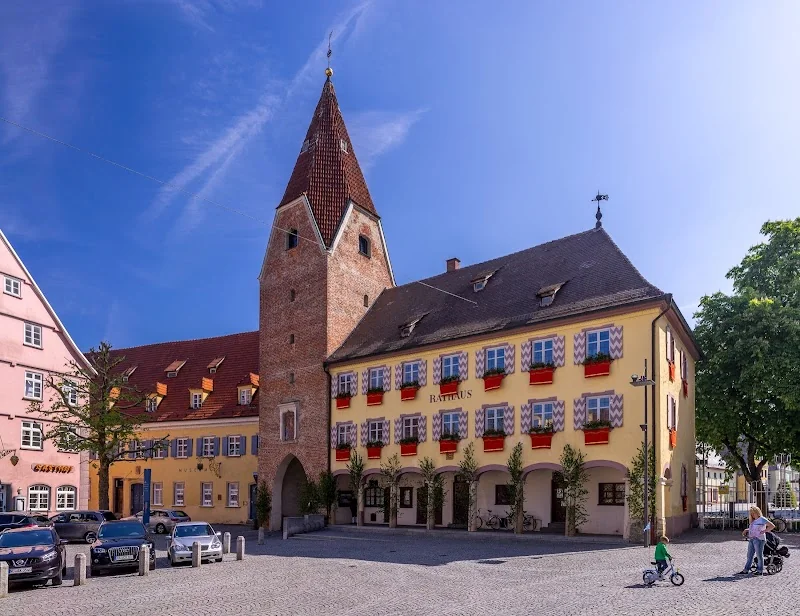
Hauptstraße, Weißenhorn
Hauptstraße, 89264 Weißenhorn, Germany
Upper Gate Weißenhorn | Old Town & History
The Upper Gate in Weißenhorn is one of those places where city history, architecture, and today's everyday life meet directly. Standing on the main street in 89264 Weißenhorn, one looks not only at a historic city gate but also at one of the most famous landmarks of the Fugger city. The gate marks the entrance to the old town, is located in direct proximity to the Catholic parish church of the Assumption of Mary, and today belongs to the Weißenhorn local museum. This connection of monument, museum, and vibrant urban space makes the Upper Gate so interesting for visitors: it is not an isolated object but an integral part of the historic center. The first impression already shows why so many people stop here, take photos, and continue into the old town. The gate not only opens a path but also provides a view into the history of Weißenhorn, the city fortifications of the late Middle Ages, the development of the church square, and the role of the place as a cultural center. Those interested in Weißenhorn attractions, the old town, city tours, or parking will quickly find themselves at the Upper Gate. It is also the starting point for walks, a motif for city views, and a symbol of how consciously Weißenhorn maintains and develops its historical heritage.
How did the Upper Gate in Weißenhorn come about?
The history of the Upper Gate is closely linked to the development of Weißenhorn as a fortified town. The town itself arose on the eastern bank of the Roth Valley from a castle settlement and was first mentioned in the 12th century. In the 13th century, the planned establishment of a town with a main street as the central axis occurred, from which narrow alleys branch off at right angles. This layout remains an important part of the urban landscape today and explains why the Upper Gate is not just an entrance but an urban planning key figure. In the course of the late medieval fortification, the large gate towers were built, which still shape Weißenhorn today. The city states that the Upper Gate originated around 1470/80 under Duke Georg the Rich, and this period marks the expansion of the city fortifications with their defensive elements. The official monument protection description also emphasizes that the city fortifications with the large gate towers are a monument of this time. For visitors, this means: The Upper Gate is not just any tower but part of a historical protection system that connected the city, trade, and political development. Over the centuries, the function of the gate changed, but its significance as a passage remained. Even when the old wall was gradually demolished in the 19th century and the moats were largely leveled, the core of the old town retained its structure. This is precisely why the Upper Gate appears so impressive today: it is a rare, well-visible testimony of that era when city walls, gates, and paths defined the image of a medieval town.
It is particularly interesting that the Upper Gate cannot be reduced to a single construction phase. The official city history shows how much the place has been repeatedly adapted, used, and reinterpreted over the centuries. The gate stands as a visible remnant of a once extensive fortification, whose basic structure is still traceable in the urban space. This is exactly why the place is exciting for anyone interested in historical city gates, city fortifications, city history, or monument protection. The Upper Gate thus represents the development of Weißenhorn from a fortified settlement to a historic old town with a strong identity. Those standing here do not just see masonry but a developed city history that tells of administration, trade, defensibility, and urban order. In the connection of the main street, church square, and city gate, it becomes visible how the town was conceived in the Middle Ages: as a clearly structured space with controlled access points and a center that has been preserved to this day. This also explains why the Upper Gate appears so frequently as a search term in connection with Weißenhorn history and the Weißenhorn old town.
Why is the Upper Gate part of the museum ensemble today?
The Upper Gate is much more than a historical passage today. The city of Weißenhorn describes it as the oldest building part of the future museum ensemble, which, together with the wool and weighing house and the old town hall, known as the Kray, is intended to form the cultural heart around the church square. In this constellation, it becomes particularly clear how closely architecture, city history, and museum work are interconnected in Weißenhorn. According to the official representation, the buildings of the ensemble have been perceived as a cohesive unit since 1809. The Upper Gate itself is described with its two fore towers and the battlement, which underscores its special defensive and architectural quality. At the same time, it is now a symbol of the city and is used in various forms as an advertising medium. For the city, the gate is thus both a monument and an identification figure. The planned museum expansion around the gate aims to show city history not abstractly but to make it experienceable in the historical space. This is precisely why the city speaks of a place for education, creativity, and curiosity, and of a center for art and culture enthusiasts. The keyword culture in the gate fits because not only exhibitions but also cultural formats are to find their place here in the future.
The official project page also makes it clear why this ensemble is being intensively renovated and redesigned. The museum was closed in 2019 due to limited load-bearing capacity, and subsequently, the strengthening of the building complex with the wool and weighing house, Upper Gate, and Kray became necessary. Substantial funding has been reserved for the project, and the static strengthening of the three buildings alone amounts to 9 million euros. This information is important for visitors because it shows that the Upper Gate is not only preserved but actively led into the future. The passage through the gate should also remain safe in the future; at the same time, a new place for the museum, education, and art academy is being created. This places the historic city gate in a modern cultural context without losing sight of its substance. This connection of preservation and development makes the Upper Gate a particularly exciting destination for all those interested in Weißenhorn attractions, local museums, Weißenhorn museum, or historical buildings in Bavaria. The gate remains not just a backdrop but becomes a building block of a new cultural center of the city.
What role does the Upper Gate play in the cityscape of Weißenhorn?
Anyone wanting to get to know Weißenhorn can hardly pass by the Upper Gate. The city describes it as a portal to the old town, and this function shapes the entire impression of the town center. The gate stands at a point where historical urban spaces are condensed: on one side, the main street begins, and on the other, the path opens into the church square and further into the old town. Right next to it is the Catholic parish church of the Assumption of Mary, built in the Maximilian style between 1865 and 1868. Together with the gate, a striking ensemble of sacred building, city gate, and old town structure is created, which continues to shape the image of Weißenhorn today. The official monument protection description emphasizes that the core of the old town has retained its structure despite the demolition of the wall in the 19th century. This is precisely why the transition at the Upper Gate is so impressive: one does not simply leave one street and enter another but feels the shift into a historically grown urban space. Weißenhorn itself is described in the official texts as being located in a picturesque setting in the Roth Valley and with a charming character. The Upper Gate is one of the buildings that make this character visible.
The gate also plays a central role in the tourist everyday life. The official city tour begins at the Upper City Gate and continues over the church square to the parish church of the Assumption of Mary, past the two castles to the Schranne. Other stops include the Lower Gate and the Holy Spirit Church. Thus, the Upper Gate is not only a single monument but the logical starting point to experience the city in its historical depth. The city also relies on the public character of the place: the gate is a motif for city views, tourist representations, and local identity. Visitors also feel this when they stand at the church square and view the gate along with the surrounding buildings. The image of the old town is particularly dense here because different layers of time overlap: medieval fortification, baroque and neoclassical renovations, historical museum use, and today's cultural planning. Therefore, the Upper Gate is not only a popular photo motif but a place where the city makes its history visible.
How do I get to the Upper Gate and where can I park?
The official address of the Upper Gate is Hauptstraße, 89264 Weißenhorn. This is practical for access because the location is very central and leads directly into the historic town center. The city of Weißenhorn provides its own local map and a separate parking overview for this purpose. Those arriving by car will find several nearby options there. The officially mentioned parking spaces include the P1 parking lot downtown, the P2 parking lot theater, and the P8 parking lot Fuggerhalle. This allows for a well-planned visit depending on the destination in the old town area. This is particularly helpful for all those who want to visit not only the gate itself but also the church square, the parish church, markets, or tours. Since the Upper Gate is located in the middle of the historic center, the last stretch is usually most pleasant on foot. This fits well with the character of the place, as the old town is compact and thrives on short distances between the attractions. The city parking page also makes it clear that the city systematically organizes parking in the center and actively guides its visitors.
During larger events, the parking situation may change. For example, the city points out in event notices that on certain days, the parking lot at the Fuggerhalle can also be used if areas of the old town or access roads are closed. This is especially important if you visit the Upper Gate in the context of a market, a tour, or a festival. The old town around the gate is a vibrant event space, so it is worthwhile to check the city's official pages before visiting. Those heading to the Upper Gate Weißenhorn will find a good basis for a relaxed arrival with the combination of local map, parking overview, and route function. Especially because the gate is located in the center, the combination of parking and a short old town tour is ideal. This leaves more time for what makes the place special: the historical atmosphere, the proximity to the most important buildings, and the direct transition from modern city life to the historic urban space. For visitors looking for Weißenhorn old town, parking, or access, the Upper Gate is thus a very accessible starting point.
What tours and markets start at the Upper Gate?
The Upper Gate is not only a building but also a starting point for experiences in Weißenhorn. The official city tour begins at the Upper City Gate and tells the city history along the most important stations of the old town. This makes the place ideal for anyone who wants to not only see Weißenhorn but also understand it. The tour leads over the church square to the parish church of the Assumption of Mary, past the two castles to the Schranne. Other stops include the Lower Gate and the Holy Spirit Church. Thus, the Upper Gate becomes the starting point of a route that connects historical architecture, religious buildings, and the layout of the old town. The city tour is therefore a very good introduction to the history of the place and a suitable hit for search queries such as Weißenhorn city tour, old town Weißenhorn, or attractions Weißenhorn. Additionally, there are night watchman tours through the Weißenhorn old town. There, one can discover the city in the evening with halberd, horn, and lantern, accompanied by songs, humorous, and also eerie stories. The meeting point is the fountain on the church square, just a few steps from the Upper Gate. Such offerings make the historic urban space particularly experienceable because they immerse the old town in an atmosphere of narration, light, and movement.
Markets also shape the environment of the Upper Gate. The city describes that the old town between the Upper and Lower Gate, as well as around the church and castle square, transforms into a colorful market hustle four times a year. The traditional merchant market invites you to stroll, browse, and enjoy. This is particularly attractive for visitors because around the Upper Gate, not only history but also the present takes place. Vendors from near and far, regional specialties, and a special old town atmosphere ensure that the gate does not seem like a museum under a glass bell but like a vibrant part of city life. This is complemented by the Schrannenmarkt, which also takes place in the historic surroundings of the old town. Therefore, those visiting the Upper Gate during market time experience not only a historic monument but an entire city quarter in motion. This mixture of heritage and everyday life makes Weißenhorn interesting: the gate is the starting point for tours, part of markets, and at the same time a fixed landmark of the city. For culture enthusiasts, families, and walkers, a place is created where different types of visits can be very well combined.
What should one know when visiting the Upper Gate?
When visiting the Upper Gate, it is especially worthwhile to look at the connection between monument, old town, and museum. The building is not an isolated single object but part of a historical group of buildings that is now being rethought and renovated. For visitors, this means: one experiences a place that not only preserves its history but actively transforms it into a new cultural use. The city articulates this claim very clearly when it describes the ensemble as a place for education, creativity, and curiosity. At the same time, the Upper Gate remains a passage into the old town and shapes the perception of the townscape. Anyone interested in how historical buildings in Weißenhorn are connected to the present and future will find here a particularly illustrative example. This is also relevant for photography, city tours, and cultural visits, as the gate connects the main street with the church square and the most important points of the old town. Especially on market days or during tours, it is worth spending a little more time because the area around the gate is particularly lively then. The official city structure makes it clear that the place is very central and offers further attractions within a short distance.
Those who want to plan the visit sensibly should therefore best combine the Upper Gate with other stations. Nearby are the parish church of the Assumption of Mary, the church square, the Schranne, and the historic ensemble around the old town hall, the Kray. This creates a compact old town tour from a single visit that summarizes the character of Weißenhorn very well. The Upper Gate is the point where many threads come together: city fortification, museum project, tourist guide, and urban orientation. This combination makes the place particularly relevant for search queries related to Weißenhorn attractions, Weißenhorn history, Upper City Gate Weißenhorn, and parking in Weißenhorn. So, for anyone looking for an authentic, historically rich destination, this building offers real urban significance and a clear role in today's city life. The Upper Gate shows very well how a small town can preserve its profile over centuries without standing still. It remains a landmark, an entrance to the old town, and part of a cultural future project at the same time.
Sources:
- City of Weißenhorn - Local Map
- City of Weißenhorn - We are renovating...
- City of Weißenhorn - Renovation and redesign of the building ensemble around the Upper Gate
- City of Weißenhorn - Parking
- District Neu-Ulm Tourism - Tour Weißenhorn
- City of Weißenhorn - Sebastian Market in the Weißenhorn Old Town
- City of Weißenhorn - Night Watchman Tour through the Weißenhorn Old Town in July
Show moreShow less
Upper Gate Weißenhorn | Old Town & History
The Upper Gate in Weißenhorn is one of those places where city history, architecture, and today's everyday life meet directly. Standing on the main street in 89264 Weißenhorn, one looks not only at a historic city gate but also at one of the most famous landmarks of the Fugger city. The gate marks the entrance to the old town, is located in direct proximity to the Catholic parish church of the Assumption of Mary, and today belongs to the Weißenhorn local museum. This connection of monument, museum, and vibrant urban space makes the Upper Gate so interesting for visitors: it is not an isolated object but an integral part of the historic center. The first impression already shows why so many people stop here, take photos, and continue into the old town. The gate not only opens a path but also provides a view into the history of Weißenhorn, the city fortifications of the late Middle Ages, the development of the church square, and the role of the place as a cultural center. Those interested in Weißenhorn attractions, the old town, city tours, or parking will quickly find themselves at the Upper Gate. It is also the starting point for walks, a motif for city views, and a symbol of how consciously Weißenhorn maintains and develops its historical heritage.
How did the Upper Gate in Weißenhorn come about?
The history of the Upper Gate is closely linked to the development of Weißenhorn as a fortified town. The town itself arose on the eastern bank of the Roth Valley from a castle settlement and was first mentioned in the 12th century. In the 13th century, the planned establishment of a town with a main street as the central axis occurred, from which narrow alleys branch off at right angles. This layout remains an important part of the urban landscape today and explains why the Upper Gate is not just an entrance but an urban planning key figure. In the course of the late medieval fortification, the large gate towers were built, which still shape Weißenhorn today. The city states that the Upper Gate originated around 1470/80 under Duke Georg the Rich, and this period marks the expansion of the city fortifications with their defensive elements. The official monument protection description also emphasizes that the city fortifications with the large gate towers are a monument of this time. For visitors, this means: The Upper Gate is not just any tower but part of a historical protection system that connected the city, trade, and political development. Over the centuries, the function of the gate changed, but its significance as a passage remained. Even when the old wall was gradually demolished in the 19th century and the moats were largely leveled, the core of the old town retained its structure. This is precisely why the Upper Gate appears so impressive today: it is a rare, well-visible testimony of that era when city walls, gates, and paths defined the image of a medieval town.
It is particularly interesting that the Upper Gate cannot be reduced to a single construction phase. The official city history shows how much the place has been repeatedly adapted, used, and reinterpreted over the centuries. The gate stands as a visible remnant of a once extensive fortification, whose basic structure is still traceable in the urban space. This is exactly why the place is exciting for anyone interested in historical city gates, city fortifications, city history, or monument protection. The Upper Gate thus represents the development of Weißenhorn from a fortified settlement to a historic old town with a strong identity. Those standing here do not just see masonry but a developed city history that tells of administration, trade, defensibility, and urban order. In the connection of the main street, church square, and city gate, it becomes visible how the town was conceived in the Middle Ages: as a clearly structured space with controlled access points and a center that has been preserved to this day. This also explains why the Upper Gate appears so frequently as a search term in connection with Weißenhorn history and the Weißenhorn old town.
Why is the Upper Gate part of the museum ensemble today?
The Upper Gate is much more than a historical passage today. The city of Weißenhorn describes it as the oldest building part of the future museum ensemble, which, together with the wool and weighing house and the old town hall, known as the Kray, is intended to form the cultural heart around the church square. In this constellation, it becomes particularly clear how closely architecture, city history, and museum work are interconnected in Weißenhorn. According to the official representation, the buildings of the ensemble have been perceived as a cohesive unit since 1809. The Upper Gate itself is described with its two fore towers and the battlement, which underscores its special defensive and architectural quality. At the same time, it is now a symbol of the city and is used in various forms as an advertising medium. For the city, the gate is thus both a monument and an identification figure. The planned museum expansion around the gate aims to show city history not abstractly but to make it experienceable in the historical space. This is precisely why the city speaks of a place for education, creativity, and curiosity, and of a center for art and culture enthusiasts. The keyword culture in the gate fits because not only exhibitions but also cultural formats are to find their place here in the future.
The official project page also makes it clear why this ensemble is being intensively renovated and redesigned. The museum was closed in 2019 due to limited load-bearing capacity, and subsequently, the strengthening of the building complex with the wool and weighing house, Upper Gate, and Kray became necessary. Substantial funding has been reserved for the project, and the static strengthening of the three buildings alone amounts to 9 million euros. This information is important for visitors because it shows that the Upper Gate is not only preserved but actively led into the future. The passage through the gate should also remain safe in the future; at the same time, a new place for the museum, education, and art academy is being created. This places the historic city gate in a modern cultural context without losing sight of its substance. This connection of preservation and development makes the Upper Gate a particularly exciting destination for all those interested in Weißenhorn attractions, local museums, Weißenhorn museum, or historical buildings in Bavaria. The gate remains not just a backdrop but becomes a building block of a new cultural center of the city.
What role does the Upper Gate play in the cityscape of Weißenhorn?
Anyone wanting to get to know Weißenhorn can hardly pass by the Upper Gate. The city describes it as a portal to the old town, and this function shapes the entire impression of the town center. The gate stands at a point where historical urban spaces are condensed: on one side, the main street begins, and on the other, the path opens into the church square and further into the old town. Right next to it is the Catholic parish church of the Assumption of Mary, built in the Maximilian style between 1865 and 1868. Together with the gate, a striking ensemble of sacred building, city gate, and old town structure is created, which continues to shape the image of Weißenhorn today. The official monument protection description emphasizes that the core of the old town has retained its structure despite the demolition of the wall in the 19th century. This is precisely why the transition at the Upper Gate is so impressive: one does not simply leave one street and enter another but feels the shift into a historically grown urban space. Weißenhorn itself is described in the official texts as being located in a picturesque setting in the Roth Valley and with a charming character. The Upper Gate is one of the buildings that make this character visible.
The gate also plays a central role in the tourist everyday life. The official city tour begins at the Upper City Gate and continues over the church square to the parish church of the Assumption of Mary, past the two castles to the Schranne. Other stops include the Lower Gate and the Holy Spirit Church. Thus, the Upper Gate is not only a single monument but the logical starting point to experience the city in its historical depth. The city also relies on the public character of the place: the gate is a motif for city views, tourist representations, and local identity. Visitors also feel this when they stand at the church square and view the gate along with the surrounding buildings. The image of the old town is particularly dense here because different layers of time overlap: medieval fortification, baroque and neoclassical renovations, historical museum use, and today's cultural planning. Therefore, the Upper Gate is not only a popular photo motif but a place where the city makes its history visible.
How do I get to the Upper Gate and where can I park?
The official address of the Upper Gate is Hauptstraße, 89264 Weißenhorn. This is practical for access because the location is very central and leads directly into the historic town center. The city of Weißenhorn provides its own local map and a separate parking overview for this purpose. Those arriving by car will find several nearby options there. The officially mentioned parking spaces include the P1 parking lot downtown, the P2 parking lot theater, and the P8 parking lot Fuggerhalle. This allows for a well-planned visit depending on the destination in the old town area. This is particularly helpful for all those who want to visit not only the gate itself but also the church square, the parish church, markets, or tours. Since the Upper Gate is located in the middle of the historic center, the last stretch is usually most pleasant on foot. This fits well with the character of the place, as the old town is compact and thrives on short distances between the attractions. The city parking page also makes it clear that the city systematically organizes parking in the center and actively guides its visitors.
During larger events, the parking situation may change. For example, the city points out in event notices that on certain days, the parking lot at the Fuggerhalle can also be used if areas of the old town or access roads are closed. This is especially important if you visit the Upper Gate in the context of a market, a tour, or a festival. The old town around the gate is a vibrant event space, so it is worthwhile to check the city's official pages before visiting. Those heading to the Upper Gate Weißenhorn will find a good basis for a relaxed arrival with the combination of local map, parking overview, and route function. Especially because the gate is located in the center, the combination of parking and a short old town tour is ideal. This leaves more time for what makes the place special: the historical atmosphere, the proximity to the most important buildings, and the direct transition from modern city life to the historic urban space. For visitors looking for Weißenhorn old town, parking, or access, the Upper Gate is thus a very accessible starting point.
What tours and markets start at the Upper Gate?
The Upper Gate is not only a building but also a starting point for experiences in Weißenhorn. The official city tour begins at the Upper City Gate and tells the city history along the most important stations of the old town. This makes the place ideal for anyone who wants to not only see Weißenhorn but also understand it. The tour leads over the church square to the parish church of the Assumption of Mary, past the two castles to the Schranne. Other stops include the Lower Gate and the Holy Spirit Church. Thus, the Upper Gate becomes the starting point of a route that connects historical architecture, religious buildings, and the layout of the old town. The city tour is therefore a very good introduction to the history of the place and a suitable hit for search queries such as Weißenhorn city tour, old town Weißenhorn, or attractions Weißenhorn. Additionally, there are night watchman tours through the Weißenhorn old town. There, one can discover the city in the evening with halberd, horn, and lantern, accompanied by songs, humorous, and also eerie stories. The meeting point is the fountain on the church square, just a few steps from the Upper Gate. Such offerings make the historic urban space particularly experienceable because they immerse the old town in an atmosphere of narration, light, and movement.
Markets also shape the environment of the Upper Gate. The city describes that the old town between the Upper and Lower Gate, as well as around the church and castle square, transforms into a colorful market hustle four times a year. The traditional merchant market invites you to stroll, browse, and enjoy. This is particularly attractive for visitors because around the Upper Gate, not only history but also the present takes place. Vendors from near and far, regional specialties, and a special old town atmosphere ensure that the gate does not seem like a museum under a glass bell but like a vibrant part of city life. This is complemented by the Schrannenmarkt, which also takes place in the historic surroundings of the old town. Therefore, those visiting the Upper Gate during market time experience not only a historic monument but an entire city quarter in motion. This mixture of heritage and everyday life makes Weißenhorn interesting: the gate is the starting point for tours, part of markets, and at the same time a fixed landmark of the city. For culture enthusiasts, families, and walkers, a place is created where different types of visits can be very well combined.
What should one know when visiting the Upper Gate?
When visiting the Upper Gate, it is especially worthwhile to look at the connection between monument, old town, and museum. The building is not an isolated single object but part of a historical group of buildings that is now being rethought and renovated. For visitors, this means: one experiences a place that not only preserves its history but actively transforms it into a new cultural use. The city articulates this claim very clearly when it describes the ensemble as a place for education, creativity, and curiosity. At the same time, the Upper Gate remains a passage into the old town and shapes the perception of the townscape. Anyone interested in how historical buildings in Weißenhorn are connected to the present and future will find here a particularly illustrative example. This is also relevant for photography, city tours, and cultural visits, as the gate connects the main street with the church square and the most important points of the old town. Especially on market days or during tours, it is worth spending a little more time because the area around the gate is particularly lively then. The official city structure makes it clear that the place is very central and offers further attractions within a short distance.
Those who want to plan the visit sensibly should therefore best combine the Upper Gate with other stations. Nearby are the parish church of the Assumption of Mary, the church square, the Schranne, and the historic ensemble around the old town hall, the Kray. This creates a compact old town tour from a single visit that summarizes the character of Weißenhorn very well. The Upper Gate is the point where many threads come together: city fortification, museum project, tourist guide, and urban orientation. This combination makes the place particularly relevant for search queries related to Weißenhorn attractions, Weißenhorn history, Upper City Gate Weißenhorn, and parking in Weißenhorn. So, for anyone looking for an authentic, historically rich destination, this building offers real urban significance and a clear role in today's city life. The Upper Gate shows very well how a small town can preserve its profile over centuries without standing still. It remains a landmark, an entrance to the old town, and part of a cultural future project at the same time.
Sources:
- City of Weißenhorn - Local Map
- City of Weißenhorn - We are renovating...
- City of Weißenhorn - Renovation and redesign of the building ensemble around the Upper Gate
- City of Weißenhorn - Parking
- District Neu-Ulm Tourism - Tour Weißenhorn
- City of Weißenhorn - Sebastian Market in the Weißenhorn Old Town
- City of Weißenhorn - Night Watchman Tour through the Weißenhorn Old Town in July
Upper Gate Weißenhorn | Old Town & History
The Upper Gate in Weißenhorn is one of those places where city history, architecture, and today's everyday life meet directly. Standing on the main street in 89264 Weißenhorn, one looks not only at a historic city gate but also at one of the most famous landmarks of the Fugger city. The gate marks the entrance to the old town, is located in direct proximity to the Catholic parish church of the Assumption of Mary, and today belongs to the Weißenhorn local museum. This connection of monument, museum, and vibrant urban space makes the Upper Gate so interesting for visitors: it is not an isolated object but an integral part of the historic center. The first impression already shows why so many people stop here, take photos, and continue into the old town. The gate not only opens a path but also provides a view into the history of Weißenhorn, the city fortifications of the late Middle Ages, the development of the church square, and the role of the place as a cultural center. Those interested in Weißenhorn attractions, the old town, city tours, or parking will quickly find themselves at the Upper Gate. It is also the starting point for walks, a motif for city views, and a symbol of how consciously Weißenhorn maintains and develops its historical heritage.
How did the Upper Gate in Weißenhorn come about?
The history of the Upper Gate is closely linked to the development of Weißenhorn as a fortified town. The town itself arose on the eastern bank of the Roth Valley from a castle settlement and was first mentioned in the 12th century. In the 13th century, the planned establishment of a town with a main street as the central axis occurred, from which narrow alleys branch off at right angles. This layout remains an important part of the urban landscape today and explains why the Upper Gate is not just an entrance but an urban planning key figure. In the course of the late medieval fortification, the large gate towers were built, which still shape Weißenhorn today. The city states that the Upper Gate originated around 1470/80 under Duke Georg the Rich, and this period marks the expansion of the city fortifications with their defensive elements. The official monument protection description also emphasizes that the city fortifications with the large gate towers are a monument of this time. For visitors, this means: The Upper Gate is not just any tower but part of a historical protection system that connected the city, trade, and political development. Over the centuries, the function of the gate changed, but its significance as a passage remained. Even when the old wall was gradually demolished in the 19th century and the moats were largely leveled, the core of the old town retained its structure. This is precisely why the Upper Gate appears so impressive today: it is a rare, well-visible testimony of that era when city walls, gates, and paths defined the image of a medieval town.
It is particularly interesting that the Upper Gate cannot be reduced to a single construction phase. The official city history shows how much the place has been repeatedly adapted, used, and reinterpreted over the centuries. The gate stands as a visible remnant of a once extensive fortification, whose basic structure is still traceable in the urban space. This is exactly why the place is exciting for anyone interested in historical city gates, city fortifications, city history, or monument protection. The Upper Gate thus represents the development of Weißenhorn from a fortified settlement to a historic old town with a strong identity. Those standing here do not just see masonry but a developed city history that tells of administration, trade, defensibility, and urban order. In the connection of the main street, church square, and city gate, it becomes visible how the town was conceived in the Middle Ages: as a clearly structured space with controlled access points and a center that has been preserved to this day. This also explains why the Upper Gate appears so frequently as a search term in connection with Weißenhorn history and the Weißenhorn old town.
Why is the Upper Gate part of the museum ensemble today?
The Upper Gate is much more than a historical passage today. The city of Weißenhorn describes it as the oldest building part of the future museum ensemble, which, together with the wool and weighing house and the old town hall, known as the Kray, is intended to form the cultural heart around the church square. In this constellation, it becomes particularly clear how closely architecture, city history, and museum work are interconnected in Weißenhorn. According to the official representation, the buildings of the ensemble have been perceived as a cohesive unit since 1809. The Upper Gate itself is described with its two fore towers and the battlement, which underscores its special defensive and architectural quality. At the same time, it is now a symbol of the city and is used in various forms as an advertising medium. For the city, the gate is thus both a monument and an identification figure. The planned museum expansion around the gate aims to show city history not abstractly but to make it experienceable in the historical space. This is precisely why the city speaks of a place for education, creativity, and curiosity, and of a center for art and culture enthusiasts. The keyword culture in the gate fits because not only exhibitions but also cultural formats are to find their place here in the future.
The official project page also makes it clear why this ensemble is being intensively renovated and redesigned. The museum was closed in 2019 due to limited load-bearing capacity, and subsequently, the strengthening of the building complex with the wool and weighing house, Upper Gate, and Kray became necessary. Substantial funding has been reserved for the project, and the static strengthening of the three buildings alone amounts to 9 million euros. This information is important for visitors because it shows that the Upper Gate is not only preserved but actively led into the future. The passage through the gate should also remain safe in the future; at the same time, a new place for the museum, education, and art academy is being created. This places the historic city gate in a modern cultural context without losing sight of its substance. This connection of preservation and development makes the Upper Gate a particularly exciting destination for all those interested in Weißenhorn attractions, local museums, Weißenhorn museum, or historical buildings in Bavaria. The gate remains not just a backdrop but becomes a building block of a new cultural center of the city.
What role does the Upper Gate play in the cityscape of Weißenhorn?
Anyone wanting to get to know Weißenhorn can hardly pass by the Upper Gate. The city describes it as a portal to the old town, and this function shapes the entire impression of the town center. The gate stands at a point where historical urban spaces are condensed: on one side, the main street begins, and on the other, the path opens into the church square and further into the old town. Right next to it is the Catholic parish church of the Assumption of Mary, built in the Maximilian style between 1865 and 1868. Together with the gate, a striking ensemble of sacred building, city gate, and old town structure is created, which continues to shape the image of Weißenhorn today. The official monument protection description emphasizes that the core of the old town has retained its structure despite the demolition of the wall in the 19th century. This is precisely why the transition at the Upper Gate is so impressive: one does not simply leave one street and enter another but feels the shift into a historically grown urban space. Weißenhorn itself is described in the official texts as being located in a picturesque setting in the Roth Valley and with a charming character. The Upper Gate is one of the buildings that make this character visible.
The gate also plays a central role in the tourist everyday life. The official city tour begins at the Upper City Gate and continues over the church square to the parish church of the Assumption of Mary, past the two castles to the Schranne. Other stops include the Lower Gate and the Holy Spirit Church. Thus, the Upper Gate is not only a single monument but the logical starting point to experience the city in its historical depth. The city also relies on the public character of the place: the gate is a motif for city views, tourist representations, and local identity. Visitors also feel this when they stand at the church square and view the gate along with the surrounding buildings. The image of the old town is particularly dense here because different layers of time overlap: medieval fortification, baroque and neoclassical renovations, historical museum use, and today's cultural planning. Therefore, the Upper Gate is not only a popular photo motif but a place where the city makes its history visible.
How do I get to the Upper Gate and where can I park?
The official address of the Upper Gate is Hauptstraße, 89264 Weißenhorn. This is practical for access because the location is very central and leads directly into the historic town center. The city of Weißenhorn provides its own local map and a separate parking overview for this purpose. Those arriving by car will find several nearby options there. The officially mentioned parking spaces include the P1 parking lot downtown, the P2 parking lot theater, and the P8 parking lot Fuggerhalle. This allows for a well-planned visit depending on the destination in the old town area. This is particularly helpful for all those who want to visit not only the gate itself but also the church square, the parish church, markets, or tours. Since the Upper Gate is located in the middle of the historic center, the last stretch is usually most pleasant on foot. This fits well with the character of the place, as the old town is compact and thrives on short distances between the attractions. The city parking page also makes it clear that the city systematically organizes parking in the center and actively guides its visitors.
During larger events, the parking situation may change. For example, the city points out in event notices that on certain days, the parking lot at the Fuggerhalle can also be used if areas of the old town or access roads are closed. This is especially important if you visit the Upper Gate in the context of a market, a tour, or a festival. The old town around the gate is a vibrant event space, so it is worthwhile to check the city's official pages before visiting. Those heading to the Upper Gate Weißenhorn will find a good basis for a relaxed arrival with the combination of local map, parking overview, and route function. Especially because the gate is located in the center, the combination of parking and a short old town tour is ideal. This leaves more time for what makes the place special: the historical atmosphere, the proximity to the most important buildings, and the direct transition from modern city life to the historic urban space. For visitors looking for Weißenhorn old town, parking, or access, the Upper Gate is thus a very accessible starting point.
What tours and markets start at the Upper Gate?
The Upper Gate is not only a building but also a starting point for experiences in Weißenhorn. The official city tour begins at the Upper City Gate and tells the city history along the most important stations of the old town. This makes the place ideal for anyone who wants to not only see Weißenhorn but also understand it. The tour leads over the church square to the parish church of the Assumption of Mary, past the two castles to the Schranne. Other stops include the Lower Gate and the Holy Spirit Church. Thus, the Upper Gate becomes the starting point of a route that connects historical architecture, religious buildings, and the layout of the old town. The city tour is therefore a very good introduction to the history of the place and a suitable hit for search queries such as Weißenhorn city tour, old town Weißenhorn, or attractions Weißenhorn. Additionally, there are night watchman tours through the Weißenhorn old town. There, one can discover the city in the evening with halberd, horn, and lantern, accompanied by songs, humorous, and also eerie stories. The meeting point is the fountain on the church square, just a few steps from the Upper Gate. Such offerings make the historic urban space particularly experienceable because they immerse the old town in an atmosphere of narration, light, and movement.
Markets also shape the environment of the Upper Gate. The city describes that the old town between the Upper and Lower Gate, as well as around the church and castle square, transforms into a colorful market hustle four times a year. The traditional merchant market invites you to stroll, browse, and enjoy. This is particularly attractive for visitors because around the Upper Gate, not only history but also the present takes place. Vendors from near and far, regional specialties, and a special old town atmosphere ensure that the gate does not seem like a museum under a glass bell but like a vibrant part of city life. This is complemented by the Schrannenmarkt, which also takes place in the historic surroundings of the old town. Therefore, those visiting the Upper Gate during market time experience not only a historic monument but an entire city quarter in motion. This mixture of heritage and everyday life makes Weißenhorn interesting: the gate is the starting point for tours, part of markets, and at the same time a fixed landmark of the city. For culture enthusiasts, families, and walkers, a place is created where different types of visits can be very well combined.
What should one know when visiting the Upper Gate?
When visiting the Upper Gate, it is especially worthwhile to look at the connection between monument, old town, and museum. The building is not an isolated single object but part of a historical group of buildings that is now being rethought and renovated. For visitors, this means: one experiences a place that not only preserves its history but actively transforms it into a new cultural use. The city articulates this claim very clearly when it describes the ensemble as a place for education, creativity, and curiosity. At the same time, the Upper Gate remains a passage into the old town and shapes the perception of the townscape. Anyone interested in how historical buildings in Weißenhorn are connected to the present and future will find here a particularly illustrative example. This is also relevant for photography, city tours, and cultural visits, as the gate connects the main street with the church square and the most important points of the old town. Especially on market days or during tours, it is worth spending a little more time because the area around the gate is particularly lively then. The official city structure makes it clear that the place is very central and offers further attractions within a short distance.
Those who want to plan the visit sensibly should therefore best combine the Upper Gate with other stations. Nearby are the parish church of the Assumption of Mary, the church square, the Schranne, and the historic ensemble around the old town hall, the Kray. This creates a compact old town tour from a single visit that summarizes the character of Weißenhorn very well. The Upper Gate is the point where many threads come together: city fortification, museum project, tourist guide, and urban orientation. This combination makes the place particularly relevant for search queries related to Weißenhorn attractions, Weißenhorn history, Upper City Gate Weißenhorn, and parking in Weißenhorn. So, for anyone looking for an authentic, historically rich destination, this building offers real urban significance and a clear role in today's city life. The Upper Gate shows very well how a small town can preserve its profile over centuries without standing still. It remains a landmark, an entrance to the old town, and part of a cultural future project at the same time.
Sources:
- City of Weißenhorn - Local Map
- City of Weißenhorn - We are renovating...
- City of Weißenhorn - Renovation and redesign of the building ensemble around the Upper Gate
- City of Weißenhorn - Parking
- District Neu-Ulm Tourism - Tour Weißenhorn
- City of Weißenhorn - Sebastian Market in the Weißenhorn Old Town
- City of Weißenhorn - Night Watchman Tour through the Weißenhorn Old Town in July
Upcoming Events
No events found
Frequently Asked Questions
Reviews
franz wolfinger
18. February 2025
There are few examples of such important city fortifications in southern Germany that are so well preserved. Added to that is the exposed location. The people of Weißenhorn are to be envied!
Nobby (Chichira)
25. April 2019
J.G. P.
26. August 2021
A stylish entrance to the old town.
Robert Schultz
4. March 2017
Pretty.
Viviane Wlk
13. September 2016
Highly recommended!