
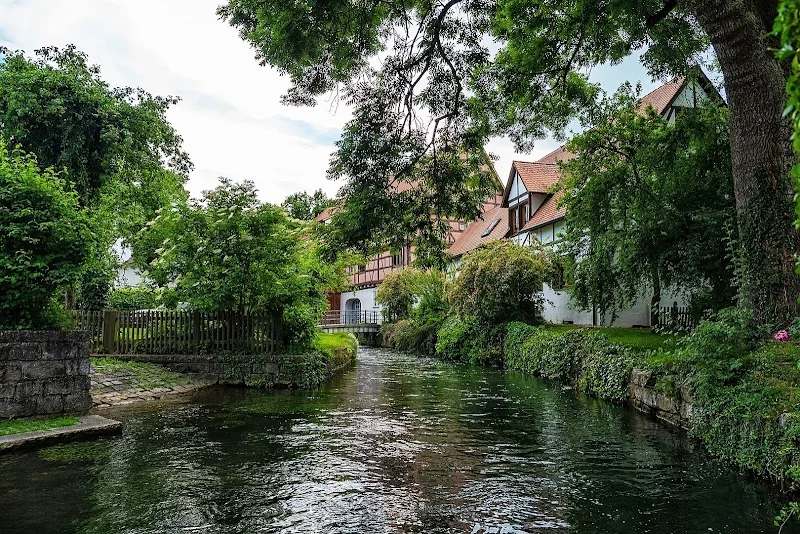
Klosterhof 18, Ulm
Klosterhof 18, 89077 Ulm, Germany
Museum in the Klostermühle | Events & Tickets
The Museum in the Klostermühle in the Ulm district of Söflingen is not an interchangeable exhibition venue, but a house with a strong local connection, clear identity, and a remarkable mix of history, volunteer work, and changing themes. Those looking for events, tickets, or opening hours will find here a museum that consciously focuses on special exhibitions, thereby creating new reasons for a visit time and again. The address at Klosterhof 18 leads right into the historical heart of Söflingen, where the Klostermühle remains visible as part of the grown ensemble to this day. Particularly important for planning: The museum is open on Sundays from 2 PM to 5 PM during the duration of the changing exhibitions; additional special opening days are announced for each exhibition. Admission is free, donations are welcome, and guided tours for groups are offered by arrangement. Currently, or in the latest announcement, the exhibition titled WITHOUT S'GELBE - Easter Eggs from Around the World is mentioned, which is accessible on Sundays from March 29, 2026, to May 10, 2026. This makes the Klostermühle ideal for visitors seeking culture, local history, and a special atmosphere. ([museum-soeflingen.de](https://museum-soeflingen.de/?utm_source=openai))
Events, Changing Exhibitions, and Current Program
Those searching for events at the Museum in the Klostermühle are actually looking for a house that primarily lives off its temporary exhibitions. The official website emphasizes that the museum is open during the duration of its changing exhibitions and does not function as a classic permanently accessible museum outside of these times. This is precisely what makes it appealing: Visits are tied to themes that each set their own focus, thus continually opening up new perspectives on Söflingen, the Klosterhof, and local culture. Previous or recent exhibitions such as MEINLOH WORLD, A Dream in PINK, and Angel Magic are mentioned as examples on the website. These themes show that the program is designed not only historically but also playfully, narratively, and visually. Therefore, for inquiries regarding program, events, or today, the respective special exhibition is particularly relevant, not a permanent standard program. The current or next mentioned exhibition WITHOUT S'GELBE - Easter Eggs from Around the World is a good example of how the museum connects local proximity with a clear thematic focus. The combination of exhibition changes, volunteer work, and a manageable, deliberately curated opening time ensures that the visit has an almost exclusive character. For this reason, it is worthwhile to check the website in advance for the current exhibition title, special opening days, and possible group tours. ([museum-soeflingen.de](https://museum-soeflingen.de/?utm_source=openai))
This form of event planning is particularly sensible for a small, locally connected museum because it gives the house a high degree of content flexibility. Instead of presenting a rigid permanent exhibition repeatedly, the Museum in the Klostermühle focuses on changing perspectives and a theme that is carried over several weeks or months. This allows the house to choose both traditional and surprisingly modern approaches, for example, when historical glass objects, Easter themes, image worlds in manga style, or seasonal cultural motifs are the focus. For visitors, this means: A new date is not just a repetition but very often a new experience. At the same time, the connection to the place is always maintained because the exhibition does not stand detached in space but takes place in a building ensemble with real historical depth. Therefore, those searching for events in Ulm-Söflingen will find here a place that is rather intimate in size but has a strong content presence. The official communication of the museum also shows that special opening days are explicitly planned depending on the exhibition, so that holidays or additional Sundays can also serve as visit dates. For an SEO search for tickets, program, or exhibition, the message is therefore clear: it is not the quantity of dates that is the characteristic, but the quality of the respective current theme. ([museum-soeflingen.de](https://museum-soeflingen.de/?utm_source=openai))
Tickets, Admission, and Opening Hours at a Glance
When searching for tickets for the Museum in the Klostermühle, the most important information is actually already the best news: Admission is free. The museum does not operate with a classic ticket model like large event venues or commercial stages, but with free access during the opening hours of the respective changing exhibition. The website and event announcement explicitly add that donations are welcome. This is typical for a house that is strongly supported by engagement and local support. Therefore, those looking for tickets should know that it is more about opening hours, exhibition phases, and possible special dates than about a purchasing process. The regular rule is: During a changing exhibition, the museum is open on Sundays from 2 PM to 5 PM. In addition, special opening days may be added; these notices are published separately each time. For groups, guided tours are available by arrangement, which is particularly practical for clubs, families, school groups, or interested small groups. This makes a simple museum visit quickly a planable cultural appointment without the need for a complex booking process in advance. Those planning a visit in spring 2026 will find the exhibition WITHOUT S'GELBE - Easter Eggs from Around the World as a specific current time window that lasts until May 10, 2026. The combination of free admission, manageable opening hours, and changing content is particularly attractive for spontaneous visits. ([museum-soeflingen.de](https://museum-soeflingen.de/?utm_source=openai))
The opening hours are also an important part of the search intention because many users are not only looking for the museum itself but also for today, open on Sundays, or opening hours Ulm-Söflingen. For this museum, the answer can be clearly formulated: It is not a place for daily standard openings, but a place for consciously selected visiting windows. This is part of its charm. Those wishing to visit the exhibition plan for Sunday between 2 PM and 5 PM or pay attention to the special opening days of the respective exhibition. This model is very sensible for volunteer-run houses because it supports the quality of care, the calm in the exhibition room, and the focus on the theme. It also fits well with the character of the building, which functions more as a historically shaped cultural place than as a continuously heavily frequented major attraction. For SEO relevance, this is also important: Terms like free admission, opening hours, open on Sundays, and group tours meet the actual user needs very precisely here. Those expecting tickets will not find a box office in the classical sense but an open cultural offer with a donation option. This transparency is particularly valuable in smaller museum locations and ensures that visitors quickly understand how the visit is organized and what they can expect. ([museum-soeflingen.de](https://museum-soeflingen.de/?utm_source=openai))
Directions, Parking, and Location in Klosterhof Söflingen
The location of the museum is one of the strongest advantages for local searches. The Museum in the Klostermühle is located at Klosterhof 18 in 89077 Ulm-Söflingen, right in the middle of a historical ensemble that still shapes the center of the Söflingen district today. Söflingen is located in the west of Ulm and, according to tourism information, maintains its own, grown district profile with a special atmosphere. Those searching for directions, parking, or Klosterhof Söflingen will therefore find not an isolated building but a place with much surrounding: The Klosterhof is the heart of the district, surrounded by historical buildings, the Kloster church, and the remnants of the old monastery complex. For practical visits, it is also important that public parking spaces with parking discs are mentioned in the Klosterhof. Additionally, the city information points out the stops Clarissenstraße and Söflingen, making the museum easily accessible by public transport. For a cultural address in a grown district, this is a clear plus, as visitors can flexibly choose between car and public transport depending on their arrival. This is particularly helpful during Sunday opening hours, as routes, parking options, and stops are often the first search terms with which visitors prepare. The journey is therefore not complicated but follows the classic route into the historical town center of Söflingen. ([museum-soeflingen.de](https://museum-soeflingen.de/kontakt.php?utm_source=openai))
The surroundings significantly contribute to the impact of the visit. The Klosterhof is not a sterile forecourt but a historically charged space where the traces of the former monastery, the baroque renovations, and the current use overlap. The tourism information describes that the former brewery and the old Klostermühle with water wheel received their baroque face and that the Klostermühle today houses the museum, which presents the development history of Söflingen and the Klosterhof. This embedding makes the journey emotionally interesting: Already on the way to the museum, one experiences not just an address but a piece of city history. For visitors who prefer to come by car, the public parking spaces in the Klosterhof with parking discs are a simple solution. For all those who prefer public transport, the stops Clarissenstraße and Söflingen are practical. The environment is thus well-structured without losing historical authenticity. Especially those coming with family, in a small group, or after a walk through Söflingen benefit from the clear location in the town center. This makes the journey a small tour through a district that has visibly preserved its history. ([tourismus.ulm.de](https://tourismus.ulm.de/de/entdecken/sehen-und-erleben/sehenswuerdigkeiten/historisches/klosterhof-soeflingen-ulm?utm_source=openai))
History of the Klosterhof and the Klostermühle
The historical depth of the place is one of the most important reasons why the Museum in the Klostermühle works so well. According to tourism information, the Klarissen monastery was already moved to Söflingen in 1258. The actual monastery building was demolished in 1818 during the secularization, but the old rectory and the former confession house have been preserved. The Kloster church dates from 1687 and was renovated and rebuilt in 1820. The surrounding buildings of the Klosterhof, including the former brewery and the old Klostermühle with water wheel, also received their baroque face. This architectural and historical layering is interesting not only for history lovers but also shapes the entire experience. The museum is therefore not simply located in any building but in a place where the history of the monastery, the secularization, later renovations, and today's cultural work become visible side by side. This spatial continuity gives the museum its credibility. It does not abstractly tell about history but stands itself in history. Those interested in the history of Söflingen, Klostermühle Ulm, or Klosterhof will find here a particularly authentic destination. The historical context also explains why the Klosterhof is still perceived as the identity-forming core of the district today. ([tourismus.ulm.de](https://tourismus.ulm.de/de/entdecken/sehen-und-erleben/sehenswuerdigkeiten/historisches/klosterhof-soeflingen-ulm?utm_source=openai))
The museum in the old mill is therefore a direct continuation of this development. The official description emphasizes that the Klostermühle today houses a museum that presents the development history of Söflingen and the Söflingen Klosterhof, where a model of the monastery can be admired. This is exciting for visitors because the exhibition not only shows individual objects but makes the connection between place, use, and memory visible. While the original monastery building has disappeared, important carriers of local history remain with the mill, the water wheel, and the surrounding buildings. This connection of architectural heritage and museum communication makes the house attractive for the search terms history, Klostermühle Ulm, and Söflingen. The fact that the museum is operated by a local association fits this historical self-understanding: It is not about a large state museum but about an engaged house with a strong connection to the neighborhood. The result is a place where history does not appear as a distant past but as a lived part of a district that has visibly preserved its traces and is continually reinterpreted. ([tourismus.ulm.de](https://tourismus.ulm.de/de/entdecken/sehen-und-erleben/sehenswuerdigkeiten/historisches/klosterhof-soeflingen-ulm?utm_source=openai))
The Museum in the Klostermühle is thus a direct continuation of this development. The official description emphasizes that the Klostermühle today houses a museum that presents the development history of Söflingen and the Söflingen Klosterhof, where a model of the monastery can be admired. This is exciting for visitors because the exhibition not only shows individual objects but makes the connection between place, use, and memory visible. While the original monastery building has disappeared, important carriers of local history remain with the mill, the water wheel, and the surrounding buildings. This connection of architectural heritage and museum communication makes the house attractive for the search terms history, Klostermühle Ulm, and Söflingen. The fact that the museum is operated by a local association fits this historical self-understanding: It is not about a large state museum but about an engaged house with a strong connection to the neighborhood. The result is a place where history does not appear as a distant past but as a lived part of a district that has visibly preserved its traces and is continually reinterpreted. ([tourismus.ulm.de](https://tourismus.ulm.de/de/entdecken/sehen-und-erleben/sehenswuerdigkeiten/historisches/klosterhof-soeflingen-ulm?utm_source=openai))
Collection, Themes, and Special Exhibits
In terms of content, the Museum in the Klostermühle sees itself as a place for local history, everyday culture, and carefully curated thematic exhibitions. The website describes that alongside the development history of Söflingen, significant Söflingen artists and everyday life in grandmother's times are also showcased. This includes traditional costumes, authentic furnishings, and dowry items, as well as a complete corner shop. This mix is strong because it appeals to both emotional memories and historical knowledge. Visitors see not only individual pieces but entire contexts: How did people live, work, shop, and celebrate? What role did textiles, ecclesiastical objects, and regional design play? This is precisely what makes the charm of this house. It is not designed for spectacular size but for the power of detail and proximity to regional everyday life. Those searching for exhibition, museum soeflingen, or klosterhof soeflingen often expect this mix of local history and lovingly presented originals. A model of the monastery is also part of the collection and is repeatedly highlighted as a central element in the official descriptions. This is didactically sensible because it makes the historical site visible in a way that makes the current building ensemble more understandable. Thus, the museum connects visual experience, memory, and local knowledge in a way that is particularly accessible for visitors without prior knowledge. ([museum-soeflingen.de](https://museum-soeflingen.de/s03.php?utm_source=openai))
Especially noteworthy is the character of the house as a lively thematic museum. The official self-presentation makes it clear that it never wanted to be a simple, conventional local museum but wanted to secure the attractiveness of the institution permanently through changing exhibitions. For this reason, according to the website, there are about one to two special exhibitions per year, each prepared by a dedicated team of volunteers. This structure also explains why the museum fits so well with search queries using the terms events and program: There is no permanent standard routine, but regularly new content occasions. This keeps the visit interesting for returnees, and at the same time, the house can also take up unusual themes. The examples of the last exhibitions show a wide range, from pink glass to Easter eggs to manga-like youth projects. For visitors, this means that the Museum in the Klostermühle not only looks back but is also open to new perspectives. This openness is a strong distinguishing feature compared to many classic local museums. Therefore, anyone looking for a place that connects regional history with changing, surprising focuses will find a very suitable destination here. ([museum-soeflingen.de](https://museum-soeflingen.de/s03.php?utm_source=openai))
Guided Tours for Groups and Practical Tips for the Visit
Practically speaking, the Museum in the Klostermühle is particularly suitable for planable, compact visits. Guided tours are offered by arrangement for groups, making the place particularly attractive for clubs, families, senior groups, school classes, or culturally interested small groups. At the same time, one should be aware of the special conditions: An event notice explicitly states that the museum is unfortunately not barrier-free. Therefore, those planning a visit with limited mobility should take this into account when preparing. This is also why prior information is important, as the opening does not take place daily but focuses on the times of the changing exhibitions. The official website and the event calendars mention the Sunday opening from 2 PM to 5 PM as well as the respective special opening days. This facilitates planning if one wants to combine a visit with a walk through Söflingen, a family outing, or a cultural afternoon program. Those only looking for tickets should know that admission is free and therefore no classic advance reservation is necessary. Instead, personal arrangement for groups is the focus. This keeps the experience deliberately manageable and approachable. For seekers who prefer a quiet, regionally shaped cultural appointment instead of a large, anonymous event, this is exactly the right kind of museum visit. ([museum-soeflingen.de](https://museum-soeflingen.de/kontakt.php?utm_source=openai))
In summary, the Museum in the Klostermühle is a very good example of how a small place can create a strong impact through smart theme selection, historical authenticity, and local anchoring. The combination of Klosterhof, Klostermühle, changing exhibitions, and free admission makes the location interesting for both spontaneous visitors and those planning specifically. For SEO search, this means: The most important terms are not just museum or ulm, but above all events, tickets, opening hours, free admission, directions, and parking. These search intentions are met content-wise by the house. At the same time, the charm of the museum lies in its special atmosphere: It is not a loud place but a place of details, memory, and concentrated discovery. Those who appreciate the historical surroundings of the Klosterhof, the changing themes, and the locally based collection will receive a visit that is deliberately decelerated. This makes the Klostermühle an address that one does not just look at once but gladly keeps in mind for the next exhibition. ([museum-soeflingen.de](https://museum-soeflingen.de/?utm_source=openai))
Sources:
- Official website of the Museum in the Klostermühle ([museum-soeflingen.de](https://museum-soeflingen.de/?utm_source=openai))
- Tourism Ulm/Neu-Ulm: Klosterhof Söflingen ([tourismus.ulm.de](https://tourismus.ulm.de/de/entdecken/sehen-und-erleben/sehenswuerdigkeiten/historisches/klosterhof-soeflingen-ulm?utm_source=openai))
- City of Ulm: Parking and public transport in Klosterhof Söflingen ([ulm.de](https://www.ulm.de/global/datenpool/organisationseinheiten/stadt-ulm/b%C3%BCrgerdienste/melde--und-ausl%C3%A4nderwesen/dienstleistungszentrum-s%C3%B6flingen?utm_source=openai))
- Event calendar Ulm/Neu-Ulm: Museum in the Klostermühle and Klostermühle Söflingen ([chancengerechtigkeitundvielfalt.ulm.de](https://chancengerechtigkeitundvielfalt.ulm.de/global/datenpool/veranstaltungen/2025/08/27/02/05/ein-traum-in-rosa-49874?utm_source=openai))
Show moreShow less
Museum in the Klostermühle | Events & Tickets
The Museum in the Klostermühle in the Ulm district of Söflingen is not an interchangeable exhibition venue, but a house with a strong local connection, clear identity, and a remarkable mix of history, volunteer work, and changing themes. Those looking for events, tickets, or opening hours will find here a museum that consciously focuses on special exhibitions, thereby creating new reasons for a visit time and again. The address at Klosterhof 18 leads right into the historical heart of Söflingen, where the Klostermühle remains visible as part of the grown ensemble to this day. Particularly important for planning: The museum is open on Sundays from 2 PM to 5 PM during the duration of the changing exhibitions; additional special opening days are announced for each exhibition. Admission is free, donations are welcome, and guided tours for groups are offered by arrangement. Currently, or in the latest announcement, the exhibition titled WITHOUT S'GELBE - Easter Eggs from Around the World is mentioned, which is accessible on Sundays from March 29, 2026, to May 10, 2026. This makes the Klostermühle ideal for visitors seeking culture, local history, and a special atmosphere. ([museum-soeflingen.de](https://museum-soeflingen.de/?utm_source=openai))
Events, Changing Exhibitions, and Current Program
Those searching for events at the Museum in the Klostermühle are actually looking for a house that primarily lives off its temporary exhibitions. The official website emphasizes that the museum is open during the duration of its changing exhibitions and does not function as a classic permanently accessible museum outside of these times. This is precisely what makes it appealing: Visits are tied to themes that each set their own focus, thus continually opening up new perspectives on Söflingen, the Klosterhof, and local culture. Previous or recent exhibitions such as MEINLOH WORLD, A Dream in PINK, and Angel Magic are mentioned as examples on the website. These themes show that the program is designed not only historically but also playfully, narratively, and visually. Therefore, for inquiries regarding program, events, or today, the respective special exhibition is particularly relevant, not a permanent standard program. The current or next mentioned exhibition WITHOUT S'GELBE - Easter Eggs from Around the World is a good example of how the museum connects local proximity with a clear thematic focus. The combination of exhibition changes, volunteer work, and a manageable, deliberately curated opening time ensures that the visit has an almost exclusive character. For this reason, it is worthwhile to check the website in advance for the current exhibition title, special opening days, and possible group tours. ([museum-soeflingen.de](https://museum-soeflingen.de/?utm_source=openai))
This form of event planning is particularly sensible for a small, locally connected museum because it gives the house a high degree of content flexibility. Instead of presenting a rigid permanent exhibition repeatedly, the Museum in the Klostermühle focuses on changing perspectives and a theme that is carried over several weeks or months. This allows the house to choose both traditional and surprisingly modern approaches, for example, when historical glass objects, Easter themes, image worlds in manga style, or seasonal cultural motifs are the focus. For visitors, this means: A new date is not just a repetition but very often a new experience. At the same time, the connection to the place is always maintained because the exhibition does not stand detached in space but takes place in a building ensemble with real historical depth. Therefore, those searching for events in Ulm-Söflingen will find here a place that is rather intimate in size but has a strong content presence. The official communication of the museum also shows that special opening days are explicitly planned depending on the exhibition, so that holidays or additional Sundays can also serve as visit dates. For an SEO search for tickets, program, or exhibition, the message is therefore clear: it is not the quantity of dates that is the characteristic, but the quality of the respective current theme. ([museum-soeflingen.de](https://museum-soeflingen.de/?utm_source=openai))
Tickets, Admission, and Opening Hours at a Glance
When searching for tickets for the Museum in the Klostermühle, the most important information is actually already the best news: Admission is free. The museum does not operate with a classic ticket model like large event venues or commercial stages, but with free access during the opening hours of the respective changing exhibition. The website and event announcement explicitly add that donations are welcome. This is typical for a house that is strongly supported by engagement and local support. Therefore, those looking for tickets should know that it is more about opening hours, exhibition phases, and possible special dates than about a purchasing process. The regular rule is: During a changing exhibition, the museum is open on Sundays from 2 PM to 5 PM. In addition, special opening days may be added; these notices are published separately each time. For groups, guided tours are available by arrangement, which is particularly practical for clubs, families, school groups, or interested small groups. This makes a simple museum visit quickly a planable cultural appointment without the need for a complex booking process in advance. Those planning a visit in spring 2026 will find the exhibition WITHOUT S'GELBE - Easter Eggs from Around the World as a specific current time window that lasts until May 10, 2026. The combination of free admission, manageable opening hours, and changing content is particularly attractive for spontaneous visits. ([museum-soeflingen.de](https://museum-soeflingen.de/?utm_source=openai))
The opening hours are also an important part of the search intention because many users are not only looking for the museum itself but also for today, open on Sundays, or opening hours Ulm-Söflingen. For this museum, the answer can be clearly formulated: It is not a place for daily standard openings, but a place for consciously selected visiting windows. This is part of its charm. Those wishing to visit the exhibition plan for Sunday between 2 PM and 5 PM or pay attention to the special opening days of the respective exhibition. This model is very sensible for volunteer-run houses because it supports the quality of care, the calm in the exhibition room, and the focus on the theme. It also fits well with the character of the building, which functions more as a historically shaped cultural place than as a continuously heavily frequented major attraction. For SEO relevance, this is also important: Terms like free admission, opening hours, open on Sundays, and group tours meet the actual user needs very precisely here. Those expecting tickets will not find a box office in the classical sense but an open cultural offer with a donation option. This transparency is particularly valuable in smaller museum locations and ensures that visitors quickly understand how the visit is organized and what they can expect. ([museum-soeflingen.de](https://museum-soeflingen.de/?utm_source=openai))
Directions, Parking, and Location in Klosterhof Söflingen
The location of the museum is one of the strongest advantages for local searches. The Museum in the Klostermühle is located at Klosterhof 18 in 89077 Ulm-Söflingen, right in the middle of a historical ensemble that still shapes the center of the Söflingen district today. Söflingen is located in the west of Ulm and, according to tourism information, maintains its own, grown district profile with a special atmosphere. Those searching for directions, parking, or Klosterhof Söflingen will therefore find not an isolated building but a place with much surrounding: The Klosterhof is the heart of the district, surrounded by historical buildings, the Kloster church, and the remnants of the old monastery complex. For practical visits, it is also important that public parking spaces with parking discs are mentioned in the Klosterhof. Additionally, the city information points out the stops Clarissenstraße and Söflingen, making the museum easily accessible by public transport. For a cultural address in a grown district, this is a clear plus, as visitors can flexibly choose between car and public transport depending on their arrival. This is particularly helpful during Sunday opening hours, as routes, parking options, and stops are often the first search terms with which visitors prepare. The journey is therefore not complicated but follows the classic route into the historical town center of Söflingen. ([museum-soeflingen.de](https://museum-soeflingen.de/kontakt.php?utm_source=openai))
The surroundings significantly contribute to the impact of the visit. The Klosterhof is not a sterile forecourt but a historically charged space where the traces of the former monastery, the baroque renovations, and the current use overlap. The tourism information describes that the former brewery and the old Klostermühle with water wheel received their baroque face and that the Klostermühle today houses the museum, which presents the development history of Söflingen and the Klosterhof. This embedding makes the journey emotionally interesting: Already on the way to the museum, one experiences not just an address but a piece of city history. For visitors who prefer to come by car, the public parking spaces in the Klosterhof with parking discs are a simple solution. For all those who prefer public transport, the stops Clarissenstraße and Söflingen are practical. The environment is thus well-structured without losing historical authenticity. Especially those coming with family, in a small group, or after a walk through Söflingen benefit from the clear location in the town center. This makes the journey a small tour through a district that has visibly preserved its history. ([tourismus.ulm.de](https://tourismus.ulm.de/de/entdecken/sehen-und-erleben/sehenswuerdigkeiten/historisches/klosterhof-soeflingen-ulm?utm_source=openai))
History of the Klosterhof and the Klostermühle
The historical depth of the place is one of the most important reasons why the Museum in the Klostermühle works so well. According to tourism information, the Klarissen monastery was already moved to Söflingen in 1258. The actual monastery building was demolished in 1818 during the secularization, but the old rectory and the former confession house have been preserved. The Kloster church dates from 1687 and was renovated and rebuilt in 1820. The surrounding buildings of the Klosterhof, including the former brewery and the old Klostermühle with water wheel, also received their baroque face. This architectural and historical layering is interesting not only for history lovers but also shapes the entire experience. The museum is therefore not simply located in any building but in a place where the history of the monastery, the secularization, later renovations, and today's cultural work become visible side by side. This spatial continuity gives the museum its credibility. It does not abstractly tell about history but stands itself in history. Those interested in the history of Söflingen, Klostermühle Ulm, or Klosterhof will find here a particularly authentic destination. The historical context also explains why the Klosterhof is still perceived as the identity-forming core of the district today. ([tourismus.ulm.de](https://tourismus.ulm.de/de/entdecken/sehen-und-erleben/sehenswuerdigkeiten/historisches/klosterhof-soeflingen-ulm?utm_source=openai))
The museum in the old mill is therefore a direct continuation of this development. The official description emphasizes that the Klostermühle today houses a museum that presents the development history of Söflingen and the Söflingen Klosterhof, where a model of the monastery can be admired. This is exciting for visitors because the exhibition not only shows individual objects but makes the connection between place, use, and memory visible. While the original monastery building has disappeared, important carriers of local history remain with the mill, the water wheel, and the surrounding buildings. This connection of architectural heritage and museum communication makes the house attractive for the search terms history, Klostermühle Ulm, and Söflingen. The fact that the museum is operated by a local association fits this historical self-understanding: It is not about a large state museum but about an engaged house with a strong connection to the neighborhood. The result is a place where history does not appear as a distant past but as a lived part of a district that has visibly preserved its traces and is continually reinterpreted. ([tourismus.ulm.de](https://tourismus.ulm.de/de/entdecken/sehen-und-erleben/sehenswuerdigkeiten/historisches/klosterhof-soeflingen-ulm?utm_source=openai))
The Museum in the Klostermühle is thus a direct continuation of this development. The official description emphasizes that the Klostermühle today houses a museum that presents the development history of Söflingen and the Söflingen Klosterhof, where a model of the monastery can be admired. This is exciting for visitors because the exhibition not only shows individual objects but makes the connection between place, use, and memory visible. While the original monastery building has disappeared, important carriers of local history remain with the mill, the water wheel, and the surrounding buildings. This connection of architectural heritage and museum communication makes the house attractive for the search terms history, Klostermühle Ulm, and Söflingen. The fact that the museum is operated by a local association fits this historical self-understanding: It is not about a large state museum but about an engaged house with a strong connection to the neighborhood. The result is a place where history does not appear as a distant past but as a lived part of a district that has visibly preserved its traces and is continually reinterpreted. ([tourismus.ulm.de](https://tourismus.ulm.de/de/entdecken/sehen-und-erleben/sehenswuerdigkeiten/historisches/klosterhof-soeflingen-ulm?utm_source=openai))
Collection, Themes, and Special Exhibits
In terms of content, the Museum in the Klostermühle sees itself as a place for local history, everyday culture, and carefully curated thematic exhibitions. The website describes that alongside the development history of Söflingen, significant Söflingen artists and everyday life in grandmother's times are also showcased. This includes traditional costumes, authentic furnishings, and dowry items, as well as a complete corner shop. This mix is strong because it appeals to both emotional memories and historical knowledge. Visitors see not only individual pieces but entire contexts: How did people live, work, shop, and celebrate? What role did textiles, ecclesiastical objects, and regional design play? This is precisely what makes the charm of this house. It is not designed for spectacular size but for the power of detail and proximity to regional everyday life. Those searching for exhibition, museum soeflingen, or klosterhof soeflingen often expect this mix of local history and lovingly presented originals. A model of the monastery is also part of the collection and is repeatedly highlighted as a central element in the official descriptions. This is didactically sensible because it makes the historical site visible in a way that makes the current building ensemble more understandable. Thus, the museum connects visual experience, memory, and local knowledge in a way that is particularly accessible for visitors without prior knowledge. ([museum-soeflingen.de](https://museum-soeflingen.de/s03.php?utm_source=openai))
Especially noteworthy is the character of the house as a lively thematic museum. The official self-presentation makes it clear that it never wanted to be a simple, conventional local museum but wanted to secure the attractiveness of the institution permanently through changing exhibitions. For this reason, according to the website, there are about one to two special exhibitions per year, each prepared by a dedicated team of volunteers. This structure also explains why the museum fits so well with search queries using the terms events and program: There is no permanent standard routine, but regularly new content occasions. This keeps the visit interesting for returnees, and at the same time, the house can also take up unusual themes. The examples of the last exhibitions show a wide range, from pink glass to Easter eggs to manga-like youth projects. For visitors, this means that the Museum in the Klostermühle not only looks back but is also open to new perspectives. This openness is a strong distinguishing feature compared to many classic local museums. Therefore, anyone looking for a place that connects regional history with changing, surprising focuses will find a very suitable destination here. ([museum-soeflingen.de](https://museum-soeflingen.de/s03.php?utm_source=openai))
Guided Tours for Groups and Practical Tips for the Visit
Practically speaking, the Museum in the Klostermühle is particularly suitable for planable, compact visits. Guided tours are offered by arrangement for groups, making the place particularly attractive for clubs, families, senior groups, school classes, or culturally interested small groups. At the same time, one should be aware of the special conditions: An event notice explicitly states that the museum is unfortunately not barrier-free. Therefore, those planning a visit with limited mobility should take this into account when preparing. This is also why prior information is important, as the opening does not take place daily but focuses on the times of the changing exhibitions. The official website and the event calendars mention the Sunday opening from 2 PM to 5 PM as well as the respective special opening days. This facilitates planning if one wants to combine a visit with a walk through Söflingen, a family outing, or a cultural afternoon program. Those only looking for tickets should know that admission is free and therefore no classic advance reservation is necessary. Instead, personal arrangement for groups is the focus. This keeps the experience deliberately manageable and approachable. For seekers who prefer a quiet, regionally shaped cultural appointment instead of a large, anonymous event, this is exactly the right kind of museum visit. ([museum-soeflingen.de](https://museum-soeflingen.de/kontakt.php?utm_source=openai))
In summary, the Museum in the Klostermühle is a very good example of how a small place can create a strong impact through smart theme selection, historical authenticity, and local anchoring. The combination of Klosterhof, Klostermühle, changing exhibitions, and free admission makes the location interesting for both spontaneous visitors and those planning specifically. For SEO search, this means: The most important terms are not just museum or ulm, but above all events, tickets, opening hours, free admission, directions, and parking. These search intentions are met content-wise by the house. At the same time, the charm of the museum lies in its special atmosphere: It is not a loud place but a place of details, memory, and concentrated discovery. Those who appreciate the historical surroundings of the Klosterhof, the changing themes, and the locally based collection will receive a visit that is deliberately decelerated. This makes the Klostermühle an address that one does not just look at once but gladly keeps in mind for the next exhibition. ([museum-soeflingen.de](https://museum-soeflingen.de/?utm_source=openai))
Sources:
- Official website of the Museum in the Klostermühle ([museum-soeflingen.de](https://museum-soeflingen.de/?utm_source=openai))
- Tourism Ulm/Neu-Ulm: Klosterhof Söflingen ([tourismus.ulm.de](https://tourismus.ulm.de/de/entdecken/sehen-und-erleben/sehenswuerdigkeiten/historisches/klosterhof-soeflingen-ulm?utm_source=openai))
- City of Ulm: Parking and public transport in Klosterhof Söflingen ([ulm.de](https://www.ulm.de/global/datenpool/organisationseinheiten/stadt-ulm/b%C3%BCrgerdienste/melde--und-ausl%C3%A4nderwesen/dienstleistungszentrum-s%C3%B6flingen?utm_source=openai))
- Event calendar Ulm/Neu-Ulm: Museum in the Klostermühle and Klostermühle Söflingen ([chancengerechtigkeitundvielfalt.ulm.de](https://chancengerechtigkeitundvielfalt.ulm.de/global/datenpool/veranstaltungen/2025/08/27/02/05/ein-traum-in-rosa-49874?utm_source=openai))
Museum in the Klostermühle | Events & Tickets
The Museum in the Klostermühle in the Ulm district of Söflingen is not an interchangeable exhibition venue, but a house with a strong local connection, clear identity, and a remarkable mix of history, volunteer work, and changing themes. Those looking for events, tickets, or opening hours will find here a museum that consciously focuses on special exhibitions, thereby creating new reasons for a visit time and again. The address at Klosterhof 18 leads right into the historical heart of Söflingen, where the Klostermühle remains visible as part of the grown ensemble to this day. Particularly important for planning: The museum is open on Sundays from 2 PM to 5 PM during the duration of the changing exhibitions; additional special opening days are announced for each exhibition. Admission is free, donations are welcome, and guided tours for groups are offered by arrangement. Currently, or in the latest announcement, the exhibition titled WITHOUT S'GELBE - Easter Eggs from Around the World is mentioned, which is accessible on Sundays from March 29, 2026, to May 10, 2026. This makes the Klostermühle ideal for visitors seeking culture, local history, and a special atmosphere. ([museum-soeflingen.de](https://museum-soeflingen.de/?utm_source=openai))
Events, Changing Exhibitions, and Current Program
Those searching for events at the Museum in the Klostermühle are actually looking for a house that primarily lives off its temporary exhibitions. The official website emphasizes that the museum is open during the duration of its changing exhibitions and does not function as a classic permanently accessible museum outside of these times. This is precisely what makes it appealing: Visits are tied to themes that each set their own focus, thus continually opening up new perspectives on Söflingen, the Klosterhof, and local culture. Previous or recent exhibitions such as MEINLOH WORLD, A Dream in PINK, and Angel Magic are mentioned as examples on the website. These themes show that the program is designed not only historically but also playfully, narratively, and visually. Therefore, for inquiries regarding program, events, or today, the respective special exhibition is particularly relevant, not a permanent standard program. The current or next mentioned exhibition WITHOUT S'GELBE - Easter Eggs from Around the World is a good example of how the museum connects local proximity with a clear thematic focus. The combination of exhibition changes, volunteer work, and a manageable, deliberately curated opening time ensures that the visit has an almost exclusive character. For this reason, it is worthwhile to check the website in advance for the current exhibition title, special opening days, and possible group tours. ([museum-soeflingen.de](https://museum-soeflingen.de/?utm_source=openai))
This form of event planning is particularly sensible for a small, locally connected museum because it gives the house a high degree of content flexibility. Instead of presenting a rigid permanent exhibition repeatedly, the Museum in the Klostermühle focuses on changing perspectives and a theme that is carried over several weeks or months. This allows the house to choose both traditional and surprisingly modern approaches, for example, when historical glass objects, Easter themes, image worlds in manga style, or seasonal cultural motifs are the focus. For visitors, this means: A new date is not just a repetition but very often a new experience. At the same time, the connection to the place is always maintained because the exhibition does not stand detached in space but takes place in a building ensemble with real historical depth. Therefore, those searching for events in Ulm-Söflingen will find here a place that is rather intimate in size but has a strong content presence. The official communication of the museum also shows that special opening days are explicitly planned depending on the exhibition, so that holidays or additional Sundays can also serve as visit dates. For an SEO search for tickets, program, or exhibition, the message is therefore clear: it is not the quantity of dates that is the characteristic, but the quality of the respective current theme. ([museum-soeflingen.de](https://museum-soeflingen.de/?utm_source=openai))
Tickets, Admission, and Opening Hours at a Glance
When searching for tickets for the Museum in the Klostermühle, the most important information is actually already the best news: Admission is free. The museum does not operate with a classic ticket model like large event venues or commercial stages, but with free access during the opening hours of the respective changing exhibition. The website and event announcement explicitly add that donations are welcome. This is typical for a house that is strongly supported by engagement and local support. Therefore, those looking for tickets should know that it is more about opening hours, exhibition phases, and possible special dates than about a purchasing process. The regular rule is: During a changing exhibition, the museum is open on Sundays from 2 PM to 5 PM. In addition, special opening days may be added; these notices are published separately each time. For groups, guided tours are available by arrangement, which is particularly practical for clubs, families, school groups, or interested small groups. This makes a simple museum visit quickly a planable cultural appointment without the need for a complex booking process in advance. Those planning a visit in spring 2026 will find the exhibition WITHOUT S'GELBE - Easter Eggs from Around the World as a specific current time window that lasts until May 10, 2026. The combination of free admission, manageable opening hours, and changing content is particularly attractive for spontaneous visits. ([museum-soeflingen.de](https://museum-soeflingen.de/?utm_source=openai))
The opening hours are also an important part of the search intention because many users are not only looking for the museum itself but also for today, open on Sundays, or opening hours Ulm-Söflingen. For this museum, the answer can be clearly formulated: It is not a place for daily standard openings, but a place for consciously selected visiting windows. This is part of its charm. Those wishing to visit the exhibition plan for Sunday between 2 PM and 5 PM or pay attention to the special opening days of the respective exhibition. This model is very sensible for volunteer-run houses because it supports the quality of care, the calm in the exhibition room, and the focus on the theme. It also fits well with the character of the building, which functions more as a historically shaped cultural place than as a continuously heavily frequented major attraction. For SEO relevance, this is also important: Terms like free admission, opening hours, open on Sundays, and group tours meet the actual user needs very precisely here. Those expecting tickets will not find a box office in the classical sense but an open cultural offer with a donation option. This transparency is particularly valuable in smaller museum locations and ensures that visitors quickly understand how the visit is organized and what they can expect. ([museum-soeflingen.de](https://museum-soeflingen.de/?utm_source=openai))
Directions, Parking, and Location in Klosterhof Söflingen
The location of the museum is one of the strongest advantages for local searches. The Museum in the Klostermühle is located at Klosterhof 18 in 89077 Ulm-Söflingen, right in the middle of a historical ensemble that still shapes the center of the Söflingen district today. Söflingen is located in the west of Ulm and, according to tourism information, maintains its own, grown district profile with a special atmosphere. Those searching for directions, parking, or Klosterhof Söflingen will therefore find not an isolated building but a place with much surrounding: The Klosterhof is the heart of the district, surrounded by historical buildings, the Kloster church, and the remnants of the old monastery complex. For practical visits, it is also important that public parking spaces with parking discs are mentioned in the Klosterhof. Additionally, the city information points out the stops Clarissenstraße and Söflingen, making the museum easily accessible by public transport. For a cultural address in a grown district, this is a clear plus, as visitors can flexibly choose between car and public transport depending on their arrival. This is particularly helpful during Sunday opening hours, as routes, parking options, and stops are often the first search terms with which visitors prepare. The journey is therefore not complicated but follows the classic route into the historical town center of Söflingen. ([museum-soeflingen.de](https://museum-soeflingen.de/kontakt.php?utm_source=openai))
The surroundings significantly contribute to the impact of the visit. The Klosterhof is not a sterile forecourt but a historically charged space where the traces of the former monastery, the baroque renovations, and the current use overlap. The tourism information describes that the former brewery and the old Klostermühle with water wheel received their baroque face and that the Klostermühle today houses the museum, which presents the development history of Söflingen and the Klosterhof. This embedding makes the journey emotionally interesting: Already on the way to the museum, one experiences not just an address but a piece of city history. For visitors who prefer to come by car, the public parking spaces in the Klosterhof with parking discs are a simple solution. For all those who prefer public transport, the stops Clarissenstraße and Söflingen are practical. The environment is thus well-structured without losing historical authenticity. Especially those coming with family, in a small group, or after a walk through Söflingen benefit from the clear location in the town center. This makes the journey a small tour through a district that has visibly preserved its history. ([tourismus.ulm.de](https://tourismus.ulm.de/de/entdecken/sehen-und-erleben/sehenswuerdigkeiten/historisches/klosterhof-soeflingen-ulm?utm_source=openai))
History of the Klosterhof and the Klostermühle
The historical depth of the place is one of the most important reasons why the Museum in the Klostermühle works so well. According to tourism information, the Klarissen monastery was already moved to Söflingen in 1258. The actual monastery building was demolished in 1818 during the secularization, but the old rectory and the former confession house have been preserved. The Kloster church dates from 1687 and was renovated and rebuilt in 1820. The surrounding buildings of the Klosterhof, including the former brewery and the old Klostermühle with water wheel, also received their baroque face. This architectural and historical layering is interesting not only for history lovers but also shapes the entire experience. The museum is therefore not simply located in any building but in a place where the history of the monastery, the secularization, later renovations, and today's cultural work become visible side by side. This spatial continuity gives the museum its credibility. It does not abstractly tell about history but stands itself in history. Those interested in the history of Söflingen, Klostermühle Ulm, or Klosterhof will find here a particularly authentic destination. The historical context also explains why the Klosterhof is still perceived as the identity-forming core of the district today. ([tourismus.ulm.de](https://tourismus.ulm.de/de/entdecken/sehen-und-erleben/sehenswuerdigkeiten/historisches/klosterhof-soeflingen-ulm?utm_source=openai))
The museum in the old mill is therefore a direct continuation of this development. The official description emphasizes that the Klostermühle today houses a museum that presents the development history of Söflingen and the Söflingen Klosterhof, where a model of the monastery can be admired. This is exciting for visitors because the exhibition not only shows individual objects but makes the connection between place, use, and memory visible. While the original monastery building has disappeared, important carriers of local history remain with the mill, the water wheel, and the surrounding buildings. This connection of architectural heritage and museum communication makes the house attractive for the search terms history, Klostermühle Ulm, and Söflingen. The fact that the museum is operated by a local association fits this historical self-understanding: It is not about a large state museum but about an engaged house with a strong connection to the neighborhood. The result is a place where history does not appear as a distant past but as a lived part of a district that has visibly preserved its traces and is continually reinterpreted. ([tourismus.ulm.de](https://tourismus.ulm.de/de/entdecken/sehen-und-erleben/sehenswuerdigkeiten/historisches/klosterhof-soeflingen-ulm?utm_source=openai))
The Museum in the Klostermühle is thus a direct continuation of this development. The official description emphasizes that the Klostermühle today houses a museum that presents the development history of Söflingen and the Söflingen Klosterhof, where a model of the monastery can be admired. This is exciting for visitors because the exhibition not only shows individual objects but makes the connection between place, use, and memory visible. While the original monastery building has disappeared, important carriers of local history remain with the mill, the water wheel, and the surrounding buildings. This connection of architectural heritage and museum communication makes the house attractive for the search terms history, Klostermühle Ulm, and Söflingen. The fact that the museum is operated by a local association fits this historical self-understanding: It is not about a large state museum but about an engaged house with a strong connection to the neighborhood. The result is a place where history does not appear as a distant past but as a lived part of a district that has visibly preserved its traces and is continually reinterpreted. ([tourismus.ulm.de](https://tourismus.ulm.de/de/entdecken/sehen-und-erleben/sehenswuerdigkeiten/historisches/klosterhof-soeflingen-ulm?utm_source=openai))
Collection, Themes, and Special Exhibits
In terms of content, the Museum in the Klostermühle sees itself as a place for local history, everyday culture, and carefully curated thematic exhibitions. The website describes that alongside the development history of Söflingen, significant Söflingen artists and everyday life in grandmother's times are also showcased. This includes traditional costumes, authentic furnishings, and dowry items, as well as a complete corner shop. This mix is strong because it appeals to both emotional memories and historical knowledge. Visitors see not only individual pieces but entire contexts: How did people live, work, shop, and celebrate? What role did textiles, ecclesiastical objects, and regional design play? This is precisely what makes the charm of this house. It is not designed for spectacular size but for the power of detail and proximity to regional everyday life. Those searching for exhibition, museum soeflingen, or klosterhof soeflingen often expect this mix of local history and lovingly presented originals. A model of the monastery is also part of the collection and is repeatedly highlighted as a central element in the official descriptions. This is didactically sensible because it makes the historical site visible in a way that makes the current building ensemble more understandable. Thus, the museum connects visual experience, memory, and local knowledge in a way that is particularly accessible for visitors without prior knowledge. ([museum-soeflingen.de](https://museum-soeflingen.de/s03.php?utm_source=openai))
Especially noteworthy is the character of the house as a lively thematic museum. The official self-presentation makes it clear that it never wanted to be a simple, conventional local museum but wanted to secure the attractiveness of the institution permanently through changing exhibitions. For this reason, according to the website, there are about one to two special exhibitions per year, each prepared by a dedicated team of volunteers. This structure also explains why the museum fits so well with search queries using the terms events and program: There is no permanent standard routine, but regularly new content occasions. This keeps the visit interesting for returnees, and at the same time, the house can also take up unusual themes. The examples of the last exhibitions show a wide range, from pink glass to Easter eggs to manga-like youth projects. For visitors, this means that the Museum in the Klostermühle not only looks back but is also open to new perspectives. This openness is a strong distinguishing feature compared to many classic local museums. Therefore, anyone looking for a place that connects regional history with changing, surprising focuses will find a very suitable destination here. ([museum-soeflingen.de](https://museum-soeflingen.de/s03.php?utm_source=openai))
Guided Tours for Groups and Practical Tips for the Visit
Practically speaking, the Museum in the Klostermühle is particularly suitable for planable, compact visits. Guided tours are offered by arrangement for groups, making the place particularly attractive for clubs, families, senior groups, school classes, or culturally interested small groups. At the same time, one should be aware of the special conditions: An event notice explicitly states that the museum is unfortunately not barrier-free. Therefore, those planning a visit with limited mobility should take this into account when preparing. This is also why prior information is important, as the opening does not take place daily but focuses on the times of the changing exhibitions. The official website and the event calendars mention the Sunday opening from 2 PM to 5 PM as well as the respective special opening days. This facilitates planning if one wants to combine a visit with a walk through Söflingen, a family outing, or a cultural afternoon program. Those only looking for tickets should know that admission is free and therefore no classic advance reservation is necessary. Instead, personal arrangement for groups is the focus. This keeps the experience deliberately manageable and approachable. For seekers who prefer a quiet, regionally shaped cultural appointment instead of a large, anonymous event, this is exactly the right kind of museum visit. ([museum-soeflingen.de](https://museum-soeflingen.de/kontakt.php?utm_source=openai))
In summary, the Museum in the Klostermühle is a very good example of how a small place can create a strong impact through smart theme selection, historical authenticity, and local anchoring. The combination of Klosterhof, Klostermühle, changing exhibitions, and free admission makes the location interesting for both spontaneous visitors and those planning specifically. For SEO search, this means: The most important terms are not just museum or ulm, but above all events, tickets, opening hours, free admission, directions, and parking. These search intentions are met content-wise by the house. At the same time, the charm of the museum lies in its special atmosphere: It is not a loud place but a place of details, memory, and concentrated discovery. Those who appreciate the historical surroundings of the Klosterhof, the changing themes, and the locally based collection will receive a visit that is deliberately decelerated. This makes the Klostermühle an address that one does not just look at once but gladly keeps in mind for the next exhibition. ([museum-soeflingen.de](https://museum-soeflingen.de/?utm_source=openai))
Sources:
- Official website of the Museum in the Klostermühle ([museum-soeflingen.de](https://museum-soeflingen.de/?utm_source=openai))
- Tourism Ulm/Neu-Ulm: Klosterhof Söflingen ([tourismus.ulm.de](https://tourismus.ulm.de/de/entdecken/sehen-und-erleben/sehenswuerdigkeiten/historisches/klosterhof-soeflingen-ulm?utm_source=openai))
- City of Ulm: Parking and public transport in Klosterhof Söflingen ([ulm.de](https://www.ulm.de/global/datenpool/organisationseinheiten/stadt-ulm/b%C3%BCrgerdienste/melde--und-ausl%C3%A4nderwesen/dienstleistungszentrum-s%C3%B6flingen?utm_source=openai))
- Event calendar Ulm/Neu-Ulm: Museum in the Klostermühle and Klostermühle Söflingen ([chancengerechtigkeitundvielfalt.ulm.de](https://chancengerechtigkeitundvielfalt.ulm.de/global/datenpool/veranstaltungen/2025/08/27/02/05/ein-traum-in-rosa-49874?utm_source=openai))
Upcoming Events
No events found
Frequently Asked Questions
Reviews
Peter W. Schwarz
8. July 2021
A short stroll through the monastery courtyard of Söflingen – a suburb of Ulm – reveals a charmingly idyllic setting. A Poor Clare monastery was established here in 1258. The main monastery building was demolished during secularization, but the old rectory and the former confessional still stand, as does the museum in the former mill. The monastery church, dating from 1820, was renovated and remodeled. The buildings surrounding the Söflingen monastery courtyard – the former brewery and the old mill with its waterwheel – were rebuilt in the Baroque style. The remaining ruins of the monastery are now enclosed by houses built around the courtyard.
Sechs Wengentor
31. December 2019
Please note – the opening hours listed on Google are incorrect! The museum is only open during temporary exhibitions on Sundays and public holidays from 2 pm to 5 pm! Sincerely, the Museum Management
Ulrich Scheller
3. November 2018
Local history of Kloster and Soeflingen. Exhibits from textiles and the church, including dog crate boxes, nativity scenes, pictures of traditional costumes... lovingly compiled. Expert guided tour.
Helmut Arndt
16. October 2023
Changing exhibitions, always worth a visit, donations appreciated, otherwise free.
Anita Biberacher
24. April 2024