
Augsburg
Fuggerpl. 1, 86150 Augsburg, Deutschland
Maximilianmuseum | Opening Hours & Directions
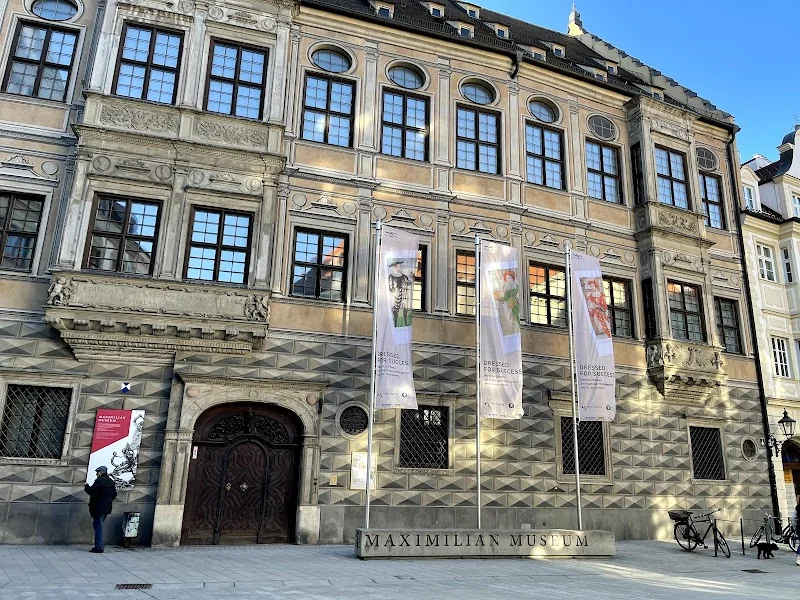
The Maximilianmuseum in Augsburg is one of the most significant cultural-historical addresses in the city and is much more than just a classic city museum. Those who enter the rooms in the historic center experience a house that does not tell the history of Augsburg abstractly, but makes it immediately tangible through objects, architecture, and spatial sequences. The museum is the oldest municipal museum in Bavaria, established in 1855 in two city palaces of Augsburg merchant dynasties, and is named after the Bavarian King Maximilian II. At the same time, it is the main house of the Art Collections and Museums Augsburg, making it a central place for goldsmithing, bronzes, scientific instruments, clocks, historical models, and city history. The contrast between the quiet location in the city center and the density of the collection is particularly appealing: behind the facades, rooms open up where Augsburg comes alive as a trading, artistic, and imperial city. For this reason, the Maximilianmuseum is suitable both for a targeted museum visit and as a cultural focal point during a stroll through the old town. ([kunstsammlungen-museen.augsburg.de](https://kunstsammlungen-museen.augsburg.de/en/museums/maximilianmuseum?utm_source=openai))
Opening Hours, Admission, and Free Access at the Maximilianmuseum
For planning, the Maximilianmuseum is pleasantly uncomplicated: The Art Collections & Museums Augsburg provide a uniform opening time for their houses from Tuesday to Sunday, each from 10 AM to 5 PM; the museum is closed on Mondays. The museum shops and the museum café in the Maximilianmuseum are also open during this time, making the visit particularly relaxed, especially on a quieter morning or afternoon. Those who want to not only view the collection but consciously savor the visit should plan enough time, as the Maximilianmuseum is not a place for a quick walkthrough. Between the permanent exhibitions, the courtyard, the historical rooms, and possible special formats, one can easily linger much longer than originally anticipated. The opening hours are set so that a visit can be well combined with a stroll through the city center or with other houses of the Art Collections & Museums Augsburg. ([kunstsammlungen-museen.augsburg.de](https://kunstsammlungen-museen.augsburg.de/))
Particularly attractive is the free access on selected days and in certain areas. The permanent exhibition at the Maximilianmuseum is free on Sundays as part of Museum Sunday, and for visitors under 27 years old, the permanent and special exhibitions at the Maximilianmuseum are generally free. Additionally, the courtyard of the Maximilianmuseum with the original bronzes of the magnificent fountains is freely accessible, making the house interesting for people who are only looking for a brief cultural-historical impression. Special exhibitions usually require admission in the houses of the Art Collections & Museums Augsburg, so it is especially worthwhile to take a quick look at the current schedule and visiting page, especially for thematic additional exhibitions. The institution also offers various discounts and special regulations for certain groups, including refugees, the cultural social ticket, and free admission with the Bavarian Volunteer Card. This makes the Maximilianmuseum not only a treasure house but also an as open as possible cultural place. ([kunstsammlungen-museen.augsburg.de](https://kunstsammlungen-museen.augsburg.de/besucherinfo/besuch))
Directions and Parking at the Maximilianmuseum in Augsburg
The Maximilianmuseum is located in the historic center of Augsburg and is therefore very central, but not automatically car-friendly. The Art Collections & Museums Augsburg explicitly recommend traveling by public transport, bicycle, or e-scooter, as parking options in the city center are limited. For guests arriving from the main train station, the free city zone is particularly convenient: Without an additional ticket, you can take the tram almost to the door of several museums. For the Maximilianmuseum, the official route is via tram lines 1 and 2 as well as bus lines 22 and 32 to Moritzplatz; from there, it is just a few minutes on foot through Philippine-Welser-Straße. This short, well-described walking route makes the visit easy to plan even for first-time guests. Those who want to combine a city walk with a museum benefit from the proximity to other central attractions and the good accessibility via public transport. ([kunstsammlungen-museen.augsburg.de](https://kunstsammlungen-museen.augsburg.de/anreise))
Visiting by car is also possible, but one should realistically plan for parking searches. The city of Augsburg points out that there are numerous parking options in the city center, but they are regulated differently, ranging from resident parking zones to time-limited or paid spaces. In addition, the city provides information about parking garages, parking guidance systems, and park-and-ride spaces. Therefore, for the Maximilianmuseum, a combination of current traffic conditions, the city's online city map, and the official parking information from the city of Augsburg is recommended. Especially those visiting the city center on weekends or during events usually find public transport more relaxing. It is also practical that the museum's location is so central that it can be easily combined with a walk from the town hall square, Moritzplatz, or other stations in the old town. This is a real advantage for those who want to not only see Augsburg but also experience its atmosphere. ([augsburg.de](https://www.augsburg.de/buergerservice-rathaus/verkehr/parken?utm_source=openai))
History of the Maximilianmuseum: From City Palace to the Oldest Municipal Museum in Bavaria
The history of the Maximilianmuseum extends far into the city and architectural history of Augsburg. The current museum location consists of two former city palaces of Augsburg merchant dynasties and is therefore itself a historical document. Even before the museum opened, personalities closely associated with the trade, art, and political history of the imperial city lived and worked here. Names such as Bartholomäus Welser, Leonhard Beck von Beckenstein, Jakob Herbrot, Anton Meuting, the Hainhofer family, and the art agent Philipp Hainhofer appear in the sources. Later, the building complex between Annastraße and Fuggerplatz served for many decades as a Protestant orphanage. When the city of Augsburg acquired the ensemble in 1853 and opened the first municipal museum in 1855, this place took on a new function without losing its historical substance. The name Maximilianmuseum refers to King Maximilian II of Bavaria and makes it clear that the house should be understood as a municipal memory. Today, it is considered the oldest municipal museum in Bavaria and was awarded the Bavarian Museum Prize in 2007. ([kunstsammlungen-museen.augsburg.de](https://kunstsammlungen-museen.augsburg.de/en/museums/maximilianmuseum))
It is also exciting how many layers of time have been preserved in the building. The Maximilianmuseum tells not only of a single era but of Augsburg as a Roman, medieval, early modern, and modern city. The official museum website particularly highlights the legendary night gate, the Old Entrance, which was built specifically for Emperor Maximilian I so that he could enter the city even late at night and is now experienceable in a virtual time travel. This connection makes it clear how the museum connects historical objects with concrete places and stories. Additionally, the significance of the house as part of the Art Collections & Museums Augsburg, which consolidate several locations and deal with collection, research, preservation, and mediation, is emphasized. Therefore, walking through the Maximilianmuseum means not only entering a single building but also a central hub of the Augsburg museum landscape, where urban development, art production, and civic memory intersect. ([kunstsammlungen-museen.augsburg.de](https://kunstsammlungen-museen.augsburg.de/maximilianmuseum))
Goldsmithing, Viermetzhof, and the Great Collections
The collection focuses of the Maximilianmuseum are among the strongest arguments for a visit. The house displays outstanding works of goldsmithing, bronze art of the late Renaissance, scientific instruments, clocks and automata, historical models, as well as city historical and decorative objects. This variety is what makes the house special, as Augsburg has been a center of craftsmanship, trade, and artistic production for centuries. The museum emphasizes that no other German city can point to comparable achievements in the field of goldsmithing. The Augsburg goldsmiths supplied princely courts, churches, synagogues, cities, citizens, and guilds throughout Europe from the 16th to the 19th century. In the museum, this international impact is not merely claimed theoretically but is visible in concrete objects. Those interested in crafts, material culture, or Augsburg's role as an economic metropolis will find a collection that goes far beyond local history. ([kunstsammlungen-museen.augsburg.de](https://kunstsammlungen-museen.augsburg.de/en/museums/maximilianmuseum))
Among the highlights is the Viermetzhof with its self-supporting glass roof, which was donated by the Augsburg honorary citizen and patron Kurt F. Viermetz. There stand the restored original sculptures of the famous Augsburg magnificent fountains, including the figures of Augustus, Mercury, and Hercules fountains, created around 1600 by Hubert Gerhard and Adriaen de Vries. These works are among the most precious pieces of the house and impressively combine art, city pride, and representation. Also noteworthy is the Aeneas Gallery with the ceiling fresco by Melchior Steidl, parts of which come from the collection of Sigmund Rohrer. The Art Collections & Museums Augsburg were established in 1932 from the merger of this collection with the holdings of the Maximilianmuseum. Additionally, there is the lapidarium in the basement with more than 300 stone testimonies, including building components, decorative elements, sculptures, inscription tablets, boundary stones, and grave monuments. Together, this creates a museum image that is not only beautiful but also historically exceptionally rich. ([kunstsammlungen-museen.augsburg.de](https://kunstsammlungen-museen.augsburg.de/maximilianmuseum))
Another strong area is the city and science history. The Maximilianmuseum presents how Augsburg became a center for mathematical, physical, and astronomical instruments since the Renaissance. Sundials, compasses, and precise measuring devices represented a craft that was in demand far beyond the regional market. Equally significant is the museum's coin collection: it includes around 1,800 pieces and documents the long minting history of Augsburg. This layer of collection often surprises visitors because it expands the museum with an economic and political perspective. Augsburg appears here not only as an art city but also as a place of monetary history, trading power, and urban self-assertion. It is precisely in this combination that the strength of the Maximilianmuseum lies: the house shows how closely art, power, craftsmanship, science, and everyday life were interconnected in the imperial city. The result is not an isolated collection but a very consciously curated narrative about Augsburg as a culturally interconnected European city. ([kunstsammlungen-museen.augsburg.de](https://kunstsammlungen-museen.augsburg.de/en/museums/maximilianmuseum))
Guided Tours, Events, and Digital Experiences at the Maximilianmuseum
The Maximilianmuseum is not a static place but a house that can be constantly reinterpreted through guided tours, educational offerings, and events. On the schedule page of the Art Collections & Museums Augsburg, regular formats can be found at the Maximilianmuseum, including tours of the permanent exhibition, thematic walks, workshops, and short formats like smART-Lunch. Special tours in various languages or inclusive offerings also appear there repeatedly. The Art Collections & Museums Augsburg also state that they organize more than 1,000 events annually, including tours, art and cultural educational offerings, and concerts. This is particularly relevant for the Maximilianmuseum because the collection is so rich in content that it lends itself very well to repeated perspective shifts. Those who visit the museum once with a focus on goldsmithing and later take a tour on city history or the magnificent fountains experience the house anew each time. Thus, the museum is suitable not only for individual visits but also for recurring visits throughout the year. ([kunstsammlungen-museen.augsburg.de](https://kunstsammlungen-museen.augsburg.de/))
Among the special educational forms is also the digital and inclusive side of the museum. The Art Collections & Museums Augsburg offer an audio tour in German and English at the Maximilianmuseum, developed by students for students. There are also tailored tours for different needs as well as further educational offerings. The Maximilianmuseum is thus not only a place of observation but also a learning place where history and art are presented in an understandable way. Particularly impressive is the virtual time travel that makes the Old Entrance and Augsburg of the 16th century experienceable. This combination of historical substance and digital mediation is a strong feature of the house because it brings the museum visit into the present without losing historical depth. For families, school classes, art-interested groups, and individual visitors, this means: The Maximilianmuseum can be accessed very differently depending on interest. This openness makes it a house that takes both education and experience seriously. ([kunstsammlungen-museen.augsburg.de](https://kunstsammlungen-museen.augsburg.de/vermittlung/angebot?utm_source=openai))
Museum Café, Shop, and Practical Visiting Tips
Those planning a visit to the Maximilianmuseum should not only consider the exhibitions but also the small practical details. The museum café and the museum shop in the Maximilianmuseum are open from Tuesday to Sunday between 10 AM and 5 PM and explicitly invite city walkers who just want to linger briefly. The offerings include coffee, cake, light meals, and drinks; in the museum shops, there are art books, exhibition catalogs, postcards, small gifts, and souvenirs. Those looking for something special can even discover honey from the Schaezler bees in the museum shops at the Schaezlerpalais and the Maximilianmuseum. These offerings make the house practical and friendly, as they extend the museum visit into a quiet stay without overwhelming it. This is a real advantage for guests who are out and about in the city center for several hours. The Maximilianmuseum is thus not only a place of seeing but also of lingering. ([kunstsammlungen-museen.augsburg.de](https://kunstsammlungen-museen.augsburg.de/shops-u-cafes))
It is also practical that the visit can be easily combined with other stations in Augsburg. Due to its central location, one can combine the museum visit with a stroll through the old town, a detour to Moritzplatz, or with other houses of the Art Collections & Museums Augsburg. Those who want to travel as relaxed as possible should use public transport and benefit from the free city zone. Those who plan their free time wisely should take advantage of Museum Sunday on Sundays or consider a visit during the week with less crowding. Also, the fact that the courtyard with the magnificent fountain bronzes is freely accessible makes the Maximilianmuseum attractive for different visitor profiles. Thus, the house remains both accessible and demanding: one can stay for half an hour or an entire afternoon. Both are fitting because the combination of architectural history, collection depth, and central location makes the place so versatile. This is precisely where the strength of the Maximilianmuseum as a cultural address in Augsburg lies. ([kunstsammlungen-museen.augsburg.de](https://kunstsammlungen-museen.augsburg.de/besucherinfo/besuch))
Sources:
- Maximilianmuseum - Art Collections and Museums Augsburg ([kunstsammlungen-museen.augsburg.de](https://kunstsammlungen-museen.augsburg.de/maximilianmuseum?utm_source=openai))
- Your Visit - Art Collections and Museums Augsburg ([kunstsammlungen-museen.augsburg.de](https://kunstsammlungen-museen.augsburg.de/besucherinfo/besuch))
- Directions - Art Collections and Museums Augsburg ([kunstsammlungen-museen.augsburg.de](https://kunstsammlungen-museen.augsburg.de/anreise))
- Shops & Cafés - Art Collections and Museums Augsburg ([kunstsammlungen-museen.augsburg.de](https://kunstsammlungen-museen.augsburg.de/shops-u-cafes))
- Events - Art Collections and Museums Augsburg ([kunstsammlungen-museen.augsburg.de](https://kunstsammlungen-museen.augsburg.de/termine?utm_source=openai))
- Parking in Augsburg - City of Augsburg ([augsburg.de](https://www.augsburg.de/buergerservice-rathaus/verkehr/parken?utm_source=openai))
Mehr anzeigenWeniger anzeigen
Maximilianmuseum | Opening Hours & Directions
The Maximilianmuseum in Augsburg is one of the most significant cultural-historical addresses in the city and is much more than just a classic city museum. Those who enter the rooms in the historic center experience a house that does not tell the history of Augsburg abstractly, but makes it immediately tangible through objects, architecture, and spatial sequences. The museum is the oldest municipal museum in Bavaria, established in 1855 in two city palaces of Augsburg merchant dynasties, and is named after the Bavarian King Maximilian II. At the same time, it is the main house of the Art Collections and Museums Augsburg, making it a central place for goldsmithing, bronzes, scientific instruments, clocks, historical models, and city history. The contrast between the quiet location in the city center and the density of the collection is particularly appealing: behind the facades, rooms open up where Augsburg comes alive as a trading, artistic, and imperial city. For this reason, the Maximilianmuseum is suitable both for a targeted museum visit and as a cultural focal point during a stroll through the old town. ([kunstsammlungen-museen.augsburg.de](https://kunstsammlungen-museen.augsburg.de/en/museums/maximilianmuseum?utm_source=openai))
Opening Hours, Admission, and Free Access at the Maximilianmuseum
For planning, the Maximilianmuseum is pleasantly uncomplicated: The Art Collections & Museums Augsburg provide a uniform opening time for their houses from Tuesday to Sunday, each from 10 AM to 5 PM; the museum is closed on Mondays. The museum shops and the museum café in the Maximilianmuseum are also open during this time, making the visit particularly relaxed, especially on a quieter morning or afternoon. Those who want to not only view the collection but consciously savor the visit should plan enough time, as the Maximilianmuseum is not a place for a quick walkthrough. Between the permanent exhibitions, the courtyard, the historical rooms, and possible special formats, one can easily linger much longer than originally anticipated. The opening hours are set so that a visit can be well combined with a stroll through the city center or with other houses of the Art Collections & Museums Augsburg. ([kunstsammlungen-museen.augsburg.de](https://kunstsammlungen-museen.augsburg.de/))
Particularly attractive is the free access on selected days and in certain areas. The permanent exhibition at the Maximilianmuseum is free on Sundays as part of Museum Sunday, and for visitors under 27 years old, the permanent and special exhibitions at the Maximilianmuseum are generally free. Additionally, the courtyard of the Maximilianmuseum with the original bronzes of the magnificent fountains is freely accessible, making the house interesting for people who are only looking for a brief cultural-historical impression. Special exhibitions usually require admission in the houses of the Art Collections & Museums Augsburg, so it is especially worthwhile to take a quick look at the current schedule and visiting page, especially for thematic additional exhibitions. The institution also offers various discounts and special regulations for certain groups, including refugees, the cultural social ticket, and free admission with the Bavarian Volunteer Card. This makes the Maximilianmuseum not only a treasure house but also an as open as possible cultural place. ([kunstsammlungen-museen.augsburg.de](https://kunstsammlungen-museen.augsburg.de/besucherinfo/besuch))
Directions and Parking at the Maximilianmuseum in Augsburg
The Maximilianmuseum is located in the historic center of Augsburg and is therefore very central, but not automatically car-friendly. The Art Collections & Museums Augsburg explicitly recommend traveling by public transport, bicycle, or e-scooter, as parking options in the city center are limited. For guests arriving from the main train station, the free city zone is particularly convenient: Without an additional ticket, you can take the tram almost to the door of several museums. For the Maximilianmuseum, the official route is via tram lines 1 and 2 as well as bus lines 22 and 32 to Moritzplatz; from there, it is just a few minutes on foot through Philippine-Welser-Straße. This short, well-described walking route makes the visit easy to plan even for first-time guests. Those who want to combine a city walk with a museum benefit from the proximity to other central attractions and the good accessibility via public transport. ([kunstsammlungen-museen.augsburg.de](https://kunstsammlungen-museen.augsburg.de/anreise))
Visiting by car is also possible, but one should realistically plan for parking searches. The city of Augsburg points out that there are numerous parking options in the city center, but they are regulated differently, ranging from resident parking zones to time-limited or paid spaces. In addition, the city provides information about parking garages, parking guidance systems, and park-and-ride spaces. Therefore, for the Maximilianmuseum, a combination of current traffic conditions, the city's online city map, and the official parking information from the city of Augsburg is recommended. Especially those visiting the city center on weekends or during events usually find public transport more relaxing. It is also practical that the museum's location is so central that it can be easily combined with a walk from the town hall square, Moritzplatz, or other stations in the old town. This is a real advantage for those who want to not only see Augsburg but also experience its atmosphere. ([augsburg.de](https://www.augsburg.de/buergerservice-rathaus/verkehr/parken?utm_source=openai))
History of the Maximilianmuseum: From City Palace to the Oldest Municipal Museum in Bavaria
The history of the Maximilianmuseum extends far into the city and architectural history of Augsburg. The current museum location consists of two former city palaces of Augsburg merchant dynasties and is therefore itself a historical document. Even before the museum opened, personalities closely associated with the trade, art, and political history of the imperial city lived and worked here. Names such as Bartholomäus Welser, Leonhard Beck von Beckenstein, Jakob Herbrot, Anton Meuting, the Hainhofer family, and the art agent Philipp Hainhofer appear in the sources. Later, the building complex between Annastraße and Fuggerplatz served for many decades as a Protestant orphanage. When the city of Augsburg acquired the ensemble in 1853 and opened the first municipal museum in 1855, this place took on a new function without losing its historical substance. The name Maximilianmuseum refers to King Maximilian II of Bavaria and makes it clear that the house should be understood as a municipal memory. Today, it is considered the oldest municipal museum in Bavaria and was awarded the Bavarian Museum Prize in 2007. ([kunstsammlungen-museen.augsburg.de](https://kunstsammlungen-museen.augsburg.de/en/museums/maximilianmuseum))
It is also exciting how many layers of time have been preserved in the building. The Maximilianmuseum tells not only of a single era but of Augsburg as a Roman, medieval, early modern, and modern city. The official museum website particularly highlights the legendary night gate, the Old Entrance, which was built specifically for Emperor Maximilian I so that he could enter the city even late at night and is now experienceable in a virtual time travel. This connection makes it clear how the museum connects historical objects with concrete places and stories. Additionally, the significance of the house as part of the Art Collections & Museums Augsburg, which consolidate several locations and deal with collection, research, preservation, and mediation, is emphasized. Therefore, walking through the Maximilianmuseum means not only entering a single building but also a central hub of the Augsburg museum landscape, where urban development, art production, and civic memory intersect. ([kunstsammlungen-museen.augsburg.de](https://kunstsammlungen-museen.augsburg.de/maximilianmuseum))
Goldsmithing, Viermetzhof, and the Great Collections
The collection focuses of the Maximilianmuseum are among the strongest arguments for a visit. The house displays outstanding works of goldsmithing, bronze art of the late Renaissance, scientific instruments, clocks and automata, historical models, as well as city historical and decorative objects. This variety is what makes the house special, as Augsburg has been a center of craftsmanship, trade, and artistic production for centuries. The museum emphasizes that no other German city can point to comparable achievements in the field of goldsmithing. The Augsburg goldsmiths supplied princely courts, churches, synagogues, cities, citizens, and guilds throughout Europe from the 16th to the 19th century. In the museum, this international impact is not merely claimed theoretically but is visible in concrete objects. Those interested in crafts, material culture, or Augsburg's role as an economic metropolis will find a collection that goes far beyond local history. ([kunstsammlungen-museen.augsburg.de](https://kunstsammlungen-museen.augsburg.de/en/museums/maximilianmuseum))
Among the highlights is the Viermetzhof with its self-supporting glass roof, which was donated by the Augsburg honorary citizen and patron Kurt F. Viermetz. There stand the restored original sculptures of the famous Augsburg magnificent fountains, including the figures of Augustus, Mercury, and Hercules fountains, created around 1600 by Hubert Gerhard and Adriaen de Vries. These works are among the most precious pieces of the house and impressively combine art, city pride, and representation. Also noteworthy is the Aeneas Gallery with the ceiling fresco by Melchior Steidl, parts of which come from the collection of Sigmund Rohrer. The Art Collections & Museums Augsburg were established in 1932 from the merger of this collection with the holdings of the Maximilianmuseum. Additionally, there is the lapidarium in the basement with more than 300 stone testimonies, including building components, decorative elements, sculptures, inscription tablets, boundary stones, and grave monuments. Together, this creates a museum image that is not only beautiful but also historically exceptionally rich. ([kunstsammlungen-museen.augsburg.de](https://kunstsammlungen-museen.augsburg.de/maximilianmuseum))
Another strong area is the city and science history. The Maximilianmuseum presents how Augsburg became a center for mathematical, physical, and astronomical instruments since the Renaissance. Sundials, compasses, and precise measuring devices represented a craft that was in demand far beyond the regional market. Equally significant is the museum's coin collection: it includes around 1,800 pieces and documents the long minting history of Augsburg. This layer of collection often surprises visitors because it expands the museum with an economic and political perspective. Augsburg appears here not only as an art city but also as a place of monetary history, trading power, and urban self-assertion. It is precisely in this combination that the strength of the Maximilianmuseum lies: the house shows how closely art, power, craftsmanship, science, and everyday life were interconnected in the imperial city. The result is not an isolated collection but a very consciously curated narrative about Augsburg as a culturally interconnected European city. ([kunstsammlungen-museen.augsburg.de](https://kunstsammlungen-museen.augsburg.de/en/museums/maximilianmuseum))
Guided Tours, Events, and Digital Experiences at the Maximilianmuseum
The Maximilianmuseum is not a static place but a house that can be constantly reinterpreted through guided tours, educational offerings, and events. On the schedule page of the Art Collections & Museums Augsburg, regular formats can be found at the Maximilianmuseum, including tours of the permanent exhibition, thematic walks, workshops, and short formats like smART-Lunch. Special tours in various languages or inclusive offerings also appear there repeatedly. The Art Collections & Museums Augsburg also state that they organize more than 1,000 events annually, including tours, art and cultural educational offerings, and concerts. This is particularly relevant for the Maximilianmuseum because the collection is so rich in content that it lends itself very well to repeated perspective shifts. Those who visit the museum once with a focus on goldsmithing and later take a tour on city history or the magnificent fountains experience the house anew each time. Thus, the museum is suitable not only for individual visits but also for recurring visits throughout the year. ([kunstsammlungen-museen.augsburg.de](https://kunstsammlungen-museen.augsburg.de/))
Among the special educational forms is also the digital and inclusive side of the museum. The Art Collections & Museums Augsburg offer an audio tour in German and English at the Maximilianmuseum, developed by students for students. There are also tailored tours for different needs as well as further educational offerings. The Maximilianmuseum is thus not only a place of observation but also a learning place where history and art are presented in an understandable way. Particularly impressive is the virtual time travel that makes the Old Entrance and Augsburg of the 16th century experienceable. This combination of historical substance and digital mediation is a strong feature of the house because it brings the museum visit into the present without losing historical depth. For families, school classes, art-interested groups, and individual visitors, this means: The Maximilianmuseum can be accessed very differently depending on interest. This openness makes it a house that takes both education and experience seriously. ([kunstsammlungen-museen.augsburg.de](https://kunstsammlungen-museen.augsburg.de/vermittlung/angebot?utm_source=openai))
Museum Café, Shop, and Practical Visiting Tips
Those planning a visit to the Maximilianmuseum should not only consider the exhibitions but also the small practical details. The museum café and the museum shop in the Maximilianmuseum are open from Tuesday to Sunday between 10 AM and 5 PM and explicitly invite city walkers who just want to linger briefly. The offerings include coffee, cake, light meals, and drinks; in the museum shops, there are art books, exhibition catalogs, postcards, small gifts, and souvenirs. Those looking for something special can even discover honey from the Schaezler bees in the museum shops at the Schaezlerpalais and the Maximilianmuseum. These offerings make the house practical and friendly, as they extend the museum visit into a quiet stay without overwhelming it. This is a real advantage for guests who are out and about in the city center for several hours. The Maximilianmuseum is thus not only a place of seeing but also of lingering. ([kunstsammlungen-museen.augsburg.de](https://kunstsammlungen-museen.augsburg.de/shops-u-cafes))
It is also practical that the visit can be easily combined with other stations in Augsburg. Due to its central location, one can combine the museum visit with a stroll through the old town, a detour to Moritzplatz, or with other houses of the Art Collections & Museums Augsburg. Those who want to travel as relaxed as possible should use public transport and benefit from the free city zone. Those who plan their free time wisely should take advantage of Museum Sunday on Sundays or consider a visit during the week with less crowding. Also, the fact that the courtyard with the magnificent fountain bronzes is freely accessible makes the Maximilianmuseum attractive for different visitor profiles. Thus, the house remains both accessible and demanding: one can stay for half an hour or an entire afternoon. Both are fitting because the combination of architectural history, collection depth, and central location makes the place so versatile. This is precisely where the strength of the Maximilianmuseum as a cultural address in Augsburg lies. ([kunstsammlungen-museen.augsburg.de](https://kunstsammlungen-museen.augsburg.de/besucherinfo/besuch))
Sources:
- Maximilianmuseum - Art Collections and Museums Augsburg ([kunstsammlungen-museen.augsburg.de](https://kunstsammlungen-museen.augsburg.de/maximilianmuseum?utm_source=openai))
- Your Visit - Art Collections and Museums Augsburg ([kunstsammlungen-museen.augsburg.de](https://kunstsammlungen-museen.augsburg.de/besucherinfo/besuch))
- Directions - Art Collections and Museums Augsburg ([kunstsammlungen-museen.augsburg.de](https://kunstsammlungen-museen.augsburg.de/anreise))
- Shops & Cafés - Art Collections and Museums Augsburg ([kunstsammlungen-museen.augsburg.de](https://kunstsammlungen-museen.augsburg.de/shops-u-cafes))
- Events - Art Collections and Museums Augsburg ([kunstsammlungen-museen.augsburg.de](https://kunstsammlungen-museen.augsburg.de/termine?utm_source=openai))
- Parking in Augsburg - City of Augsburg ([augsburg.de](https://www.augsburg.de/buergerservice-rathaus/verkehr/parken?utm_source=openai))
Maximilianmuseum | Opening Hours & Directions
The Maximilianmuseum in Augsburg is one of the most significant cultural-historical addresses in the city and is much more than just a classic city museum. Those who enter the rooms in the historic center experience a house that does not tell the history of Augsburg abstractly, but makes it immediately tangible through objects, architecture, and spatial sequences. The museum is the oldest municipal museum in Bavaria, established in 1855 in two city palaces of Augsburg merchant dynasties, and is named after the Bavarian King Maximilian II. At the same time, it is the main house of the Art Collections and Museums Augsburg, making it a central place for goldsmithing, bronzes, scientific instruments, clocks, historical models, and city history. The contrast between the quiet location in the city center and the density of the collection is particularly appealing: behind the facades, rooms open up where Augsburg comes alive as a trading, artistic, and imperial city. For this reason, the Maximilianmuseum is suitable both for a targeted museum visit and as a cultural focal point during a stroll through the old town. ([kunstsammlungen-museen.augsburg.de](https://kunstsammlungen-museen.augsburg.de/en/museums/maximilianmuseum?utm_source=openai))
Opening Hours, Admission, and Free Access at the Maximilianmuseum
For planning, the Maximilianmuseum is pleasantly uncomplicated: The Art Collections & Museums Augsburg provide a uniform opening time for their houses from Tuesday to Sunday, each from 10 AM to 5 PM; the museum is closed on Mondays. The museum shops and the museum café in the Maximilianmuseum are also open during this time, making the visit particularly relaxed, especially on a quieter morning or afternoon. Those who want to not only view the collection but consciously savor the visit should plan enough time, as the Maximilianmuseum is not a place for a quick walkthrough. Between the permanent exhibitions, the courtyard, the historical rooms, and possible special formats, one can easily linger much longer than originally anticipated. The opening hours are set so that a visit can be well combined with a stroll through the city center or with other houses of the Art Collections & Museums Augsburg. ([kunstsammlungen-museen.augsburg.de](https://kunstsammlungen-museen.augsburg.de/))
Particularly attractive is the free access on selected days and in certain areas. The permanent exhibition at the Maximilianmuseum is free on Sundays as part of Museum Sunday, and for visitors under 27 years old, the permanent and special exhibitions at the Maximilianmuseum are generally free. Additionally, the courtyard of the Maximilianmuseum with the original bronzes of the magnificent fountains is freely accessible, making the house interesting for people who are only looking for a brief cultural-historical impression. Special exhibitions usually require admission in the houses of the Art Collections & Museums Augsburg, so it is especially worthwhile to take a quick look at the current schedule and visiting page, especially for thematic additional exhibitions. The institution also offers various discounts and special regulations for certain groups, including refugees, the cultural social ticket, and free admission with the Bavarian Volunteer Card. This makes the Maximilianmuseum not only a treasure house but also an as open as possible cultural place. ([kunstsammlungen-museen.augsburg.de](https://kunstsammlungen-museen.augsburg.de/besucherinfo/besuch))
Directions and Parking at the Maximilianmuseum in Augsburg
The Maximilianmuseum is located in the historic center of Augsburg and is therefore very central, but not automatically car-friendly. The Art Collections & Museums Augsburg explicitly recommend traveling by public transport, bicycle, or e-scooter, as parking options in the city center are limited. For guests arriving from the main train station, the free city zone is particularly convenient: Without an additional ticket, you can take the tram almost to the door of several museums. For the Maximilianmuseum, the official route is via tram lines 1 and 2 as well as bus lines 22 and 32 to Moritzplatz; from there, it is just a few minutes on foot through Philippine-Welser-Straße. This short, well-described walking route makes the visit easy to plan even for first-time guests. Those who want to combine a city walk with a museum benefit from the proximity to other central attractions and the good accessibility via public transport. ([kunstsammlungen-museen.augsburg.de](https://kunstsammlungen-museen.augsburg.de/anreise))
Visiting by car is also possible, but one should realistically plan for parking searches. The city of Augsburg points out that there are numerous parking options in the city center, but they are regulated differently, ranging from resident parking zones to time-limited or paid spaces. In addition, the city provides information about parking garages, parking guidance systems, and park-and-ride spaces. Therefore, for the Maximilianmuseum, a combination of current traffic conditions, the city's online city map, and the official parking information from the city of Augsburg is recommended. Especially those visiting the city center on weekends or during events usually find public transport more relaxing. It is also practical that the museum's location is so central that it can be easily combined with a walk from the town hall square, Moritzplatz, or other stations in the old town. This is a real advantage for those who want to not only see Augsburg but also experience its atmosphere. ([augsburg.de](https://www.augsburg.de/buergerservice-rathaus/verkehr/parken?utm_source=openai))
History of the Maximilianmuseum: From City Palace to the Oldest Municipal Museum in Bavaria
The history of the Maximilianmuseum extends far into the city and architectural history of Augsburg. The current museum location consists of two former city palaces of Augsburg merchant dynasties and is therefore itself a historical document. Even before the museum opened, personalities closely associated with the trade, art, and political history of the imperial city lived and worked here. Names such as Bartholomäus Welser, Leonhard Beck von Beckenstein, Jakob Herbrot, Anton Meuting, the Hainhofer family, and the art agent Philipp Hainhofer appear in the sources. Later, the building complex between Annastraße and Fuggerplatz served for many decades as a Protestant orphanage. When the city of Augsburg acquired the ensemble in 1853 and opened the first municipal museum in 1855, this place took on a new function without losing its historical substance. The name Maximilianmuseum refers to King Maximilian II of Bavaria and makes it clear that the house should be understood as a municipal memory. Today, it is considered the oldest municipal museum in Bavaria and was awarded the Bavarian Museum Prize in 2007. ([kunstsammlungen-museen.augsburg.de](https://kunstsammlungen-museen.augsburg.de/en/museums/maximilianmuseum))
It is also exciting how many layers of time have been preserved in the building. The Maximilianmuseum tells not only of a single era but of Augsburg as a Roman, medieval, early modern, and modern city. The official museum website particularly highlights the legendary night gate, the Old Entrance, which was built specifically for Emperor Maximilian I so that he could enter the city even late at night and is now experienceable in a virtual time travel. This connection makes it clear how the museum connects historical objects with concrete places and stories. Additionally, the significance of the house as part of the Art Collections & Museums Augsburg, which consolidate several locations and deal with collection, research, preservation, and mediation, is emphasized. Therefore, walking through the Maximilianmuseum means not only entering a single building but also a central hub of the Augsburg museum landscape, where urban development, art production, and civic memory intersect. ([kunstsammlungen-museen.augsburg.de](https://kunstsammlungen-museen.augsburg.de/maximilianmuseum))
Goldsmithing, Viermetzhof, and the Great Collections
The collection focuses of the Maximilianmuseum are among the strongest arguments for a visit. The house displays outstanding works of goldsmithing, bronze art of the late Renaissance, scientific instruments, clocks and automata, historical models, as well as city historical and decorative objects. This variety is what makes the house special, as Augsburg has been a center of craftsmanship, trade, and artistic production for centuries. The museum emphasizes that no other German city can point to comparable achievements in the field of goldsmithing. The Augsburg goldsmiths supplied princely courts, churches, synagogues, cities, citizens, and guilds throughout Europe from the 16th to the 19th century. In the museum, this international impact is not merely claimed theoretically but is visible in concrete objects. Those interested in crafts, material culture, or Augsburg's role as an economic metropolis will find a collection that goes far beyond local history. ([kunstsammlungen-museen.augsburg.de](https://kunstsammlungen-museen.augsburg.de/en/museums/maximilianmuseum))
Among the highlights is the Viermetzhof with its self-supporting glass roof, which was donated by the Augsburg honorary citizen and patron Kurt F. Viermetz. There stand the restored original sculptures of the famous Augsburg magnificent fountains, including the figures of Augustus, Mercury, and Hercules fountains, created around 1600 by Hubert Gerhard and Adriaen de Vries. These works are among the most precious pieces of the house and impressively combine art, city pride, and representation. Also noteworthy is the Aeneas Gallery with the ceiling fresco by Melchior Steidl, parts of which come from the collection of Sigmund Rohrer. The Art Collections & Museums Augsburg were established in 1932 from the merger of this collection with the holdings of the Maximilianmuseum. Additionally, there is the lapidarium in the basement with more than 300 stone testimonies, including building components, decorative elements, sculptures, inscription tablets, boundary stones, and grave monuments. Together, this creates a museum image that is not only beautiful but also historically exceptionally rich. ([kunstsammlungen-museen.augsburg.de](https://kunstsammlungen-museen.augsburg.de/maximilianmuseum))
Another strong area is the city and science history. The Maximilianmuseum presents how Augsburg became a center for mathematical, physical, and astronomical instruments since the Renaissance. Sundials, compasses, and precise measuring devices represented a craft that was in demand far beyond the regional market. Equally significant is the museum's coin collection: it includes around 1,800 pieces and documents the long minting history of Augsburg. This layer of collection often surprises visitors because it expands the museum with an economic and political perspective. Augsburg appears here not only as an art city but also as a place of monetary history, trading power, and urban self-assertion. It is precisely in this combination that the strength of the Maximilianmuseum lies: the house shows how closely art, power, craftsmanship, science, and everyday life were interconnected in the imperial city. The result is not an isolated collection but a very consciously curated narrative about Augsburg as a culturally interconnected European city. ([kunstsammlungen-museen.augsburg.de](https://kunstsammlungen-museen.augsburg.de/en/museums/maximilianmuseum))
Guided Tours, Events, and Digital Experiences at the Maximilianmuseum
The Maximilianmuseum is not a static place but a house that can be constantly reinterpreted through guided tours, educational offerings, and events. On the schedule page of the Art Collections & Museums Augsburg, regular formats can be found at the Maximilianmuseum, including tours of the permanent exhibition, thematic walks, workshops, and short formats like smART-Lunch. Special tours in various languages or inclusive offerings also appear there repeatedly. The Art Collections & Museums Augsburg also state that they organize more than 1,000 events annually, including tours, art and cultural educational offerings, and concerts. This is particularly relevant for the Maximilianmuseum because the collection is so rich in content that it lends itself very well to repeated perspective shifts. Those who visit the museum once with a focus on goldsmithing and later take a tour on city history or the magnificent fountains experience the house anew each time. Thus, the museum is suitable not only for individual visits but also for recurring visits throughout the year. ([kunstsammlungen-museen.augsburg.de](https://kunstsammlungen-museen.augsburg.de/))
Among the special educational forms is also the digital and inclusive side of the museum. The Art Collections & Museums Augsburg offer an audio tour in German and English at the Maximilianmuseum, developed by students for students. There are also tailored tours for different needs as well as further educational offerings. The Maximilianmuseum is thus not only a place of observation but also a learning place where history and art are presented in an understandable way. Particularly impressive is the virtual time travel that makes the Old Entrance and Augsburg of the 16th century experienceable. This combination of historical substance and digital mediation is a strong feature of the house because it brings the museum visit into the present without losing historical depth. For families, school classes, art-interested groups, and individual visitors, this means: The Maximilianmuseum can be accessed very differently depending on interest. This openness makes it a house that takes both education and experience seriously. ([kunstsammlungen-museen.augsburg.de](https://kunstsammlungen-museen.augsburg.de/vermittlung/angebot?utm_source=openai))
Museum Café, Shop, and Practical Visiting Tips
Those planning a visit to the Maximilianmuseum should not only consider the exhibitions but also the small practical details. The museum café and the museum shop in the Maximilianmuseum are open from Tuesday to Sunday between 10 AM and 5 PM and explicitly invite city walkers who just want to linger briefly. The offerings include coffee, cake, light meals, and drinks; in the museum shops, there are art books, exhibition catalogs, postcards, small gifts, and souvenirs. Those looking for something special can even discover honey from the Schaezler bees in the museum shops at the Schaezlerpalais and the Maximilianmuseum. These offerings make the house practical and friendly, as they extend the museum visit into a quiet stay without overwhelming it. This is a real advantage for guests who are out and about in the city center for several hours. The Maximilianmuseum is thus not only a place of seeing but also of lingering. ([kunstsammlungen-museen.augsburg.de](https://kunstsammlungen-museen.augsburg.de/shops-u-cafes))
It is also practical that the visit can be easily combined with other stations in Augsburg. Due to its central location, one can combine the museum visit with a stroll through the old town, a detour to Moritzplatz, or with other houses of the Art Collections & Museums Augsburg. Those who want to travel as relaxed as possible should use public transport and benefit from the free city zone. Those who plan their free time wisely should take advantage of Museum Sunday on Sundays or consider a visit during the week with less crowding. Also, the fact that the courtyard with the magnificent fountain bronzes is freely accessible makes the Maximilianmuseum attractive for different visitor profiles. Thus, the house remains both accessible and demanding: one can stay for half an hour or an entire afternoon. Both are fitting because the combination of architectural history, collection depth, and central location makes the place so versatile. This is precisely where the strength of the Maximilianmuseum as a cultural address in Augsburg lies. ([kunstsammlungen-museen.augsburg.de](https://kunstsammlungen-museen.augsburg.de/besucherinfo/besuch))
Sources:
- Maximilianmuseum - Art Collections and Museums Augsburg ([kunstsammlungen-museen.augsburg.de](https://kunstsammlungen-museen.augsburg.de/maximilianmuseum?utm_source=openai))
- Your Visit - Art Collections and Museums Augsburg ([kunstsammlungen-museen.augsburg.de](https://kunstsammlungen-museen.augsburg.de/besucherinfo/besuch))
- Directions - Art Collections and Museums Augsburg ([kunstsammlungen-museen.augsburg.de](https://kunstsammlungen-museen.augsburg.de/anreise))
- Shops & Cafés - Art Collections and Museums Augsburg ([kunstsammlungen-museen.augsburg.de](https://kunstsammlungen-museen.augsburg.de/shops-u-cafes))
- Events - Art Collections and Museums Augsburg ([kunstsammlungen-museen.augsburg.de](https://kunstsammlungen-museen.augsburg.de/termine?utm_source=openai))
- Parking in Augsburg - City of Augsburg ([augsburg.de](https://www.augsburg.de/buergerservice-rathaus/verkehr/parken?utm_source=openai))
Upcoming Events

Frequently Asked Questions
Reviews
Raymond Young
18. December 2025
I had a fantastic time visiting the Augsburg Maximilian Museum. The museum itself is really beautiful, well organized, and easy to walk through, with a great mix of history and art that keeps things interesting the whole way. You can tell a lot of thought went into how everything is presented. What truly made the visit stand out, though, was the staff. Everyone I interacted with was genuinely kind, approachable, and happy to help. It created such a welcoming atmosphere and made the experience feel relaxed and enjoyable rather than rushed or formal. A special thank you to Patricia W., she was absolutely wonderful. Very friendly, knowledgeable, and professional, and she made a real difference in my visit. Small interactions like that really stay with you and show how much the people here care about visitors. Overall, I was really impressed and left with a great feeling. Highly recommend stopping by if you’re in Augsburg, it’s well worth the time.
Florin Matache
21. October 2025
A rich and informative museum on the history of the city. Must see when in Augsburg.
Tjoy Sherrod
2. May 2025
Lovely museum with very helpful staff. Entrance fee is 7 Euro per person. But if you go as a group of 10 it will become 5 Euro per person.
david antoun
21. August 2023
Entrance 12€. Divided in 3 floors between sculptures, history of the Monument in Augsburg, collection of the famous artist Elias Holl and old writings and documents. Follow the golden stripe on the floor so you won’t lose trail in each part of the Museum.
THE LUCKY BOY
14. September 2024
If you have time and come to Augsburg, you must visit this place it’s really nice. Beautiful things to see, all of them part of history.