
Hella Santarossa
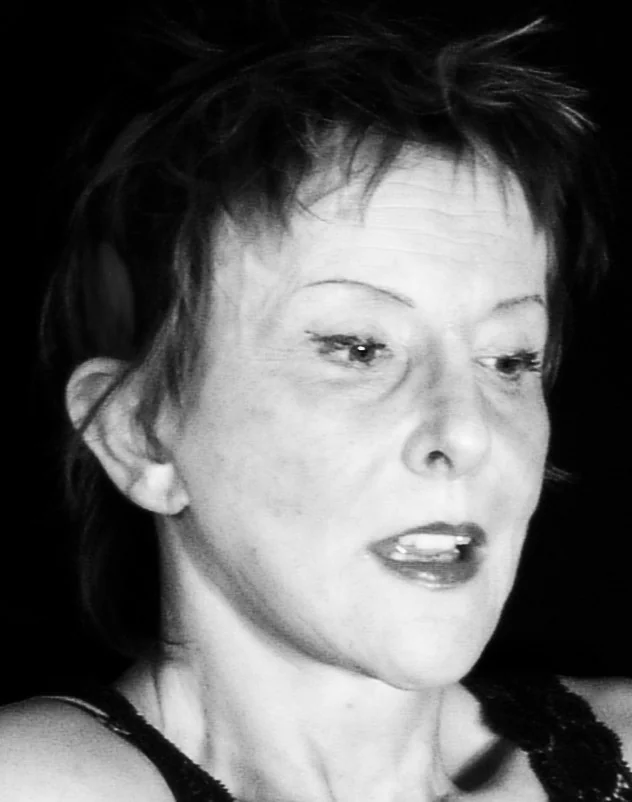
Image from Wikipedia
Image from Wikipedia
Hella De Santarossa: The Radical Visual Language of a Cross-Art Pioneer
An artist who brings together painting, glass, performance, and film into a distinctive signature
Hella Santarossa, also known as Hella De Santarossa since 2002, is one of the most prominent German artists of post-war and contemporary art. Born in 1949 in Düsseldorf-Kaiserswerth, she has been creating art that does not accept disciplinary boundaries from an early age, instead understanding it as an open field between painting, glass, sculpture, photography, and film. Her works can be found in the Berlin Reichstag, in public spaces, churches, museums, and collections, and her name is still associated with the neo-expressionist movement of the Young Wild Ones. ([de.wikipedia.org](https://de.wikipedia.org/wiki/Hella_Santarossa))
Biography: From Düsseldorf to West Berlin and into the International Art Scene
Hella De Santarossa's artistic journey began with an apprenticeship as a glass painter, leading her to Berlin in the 1970s, where she studied at the Hochschule der Künste under K. H. Hödicke and became a master student in 1979. During this time, she was part of the West Berlin scene of the "Young Wild Ones," which reacted to the art debates of the time with spontaneous, intense, figurative painting. Early on, she combined a strong interest in sensual color, expressive gesture, and the overcoming of academic rules with a pronounced awareness of material and space. ([de.wikipedia.org](https://de.wikipedia.org/wiki/Hella_Santarossa))
The artist's biography is also a story of international movement. Study and work stays took her in 1979 to the Art Institute in San Francisco, later to Florence, Rome, and Olevano, as well as a trip to Brazil in 1984 on the invitation of the Goethe Institutes. These experiences left visible traces in her work, which repeatedly engages with places, cultures, and ritual imagery. The exchange with international art contexts contributed to her early visibility and strengthened her reputation as an independent position beyond trendy attributions. ([de.wikipedia.org](https://de.wikipedia.org/wiki/Hella_Santarossa))
Career: Exhibitions, Teaching, and Public Commissions
Alongside her own artistic development, Hella De Santarossa began taking guest professorships in 1982, including in Berlin, Oslo, London, Sydney, and Melbourne. This not only indicates recognition in the academic world but also highlights her role as a mediator of an artistic attitude that emphasizes process, experimentation, and crossing boundaries. From 1987 to 1996, she additionally managed her family business while consistently remaining productive in the studio and present in exhibitions. ([de.wikipedia.org](https://de.wikipedia.org/wiki/Hella_Santarossa))
Particularly significant for her career are works in public space. In 1987, she won the competition for the redesign of Theodor-Heuss-Platz with the glass fountain object "Blue Obelisk," which was completed in 1995 and is still regarded as a symbol of artistic intervention in urban space. Her 30-meter-long picture frieze "The Red-White Cart," created in 1988, is also well-known, having hung in the SPD faction room in the Reichstag since 2001. Such projects connect artistic authorship with political and social memory. ([de.wikipedia.org](https://de.wikipedia.org/wiki/Hella_Santarossa))
Art Development: Neo-Expressionism, Cross-Art, and Material Transgression
Stylistically, Hella De Santarossa is characterized by an expressive, figurative, and neo-expressionist approach that does not end with the classical canvas. Her works consistently transcend stylistic and material boundaries and were later received under the term "Cross-Art." This is precisely where her uniqueness lies: painting is not treated as a closed genre, but rather as part of an expanded artistic system in which glass, installation, performance, and film merge thematically and formally. ([de.wikipedia.org](https://de.wikipedia.org/wiki/Hella_Santarossa))
The artist herself described her approach as open work with materials and contexts, in which light serves as a fundamental driving force of her art. This is especially evident in her glass works and window projects for churches, which not only illustrate religious themes but translate them into a contemporary visual language. Works such as the windows of the Christ Pavilion at Expo 2000 in Hannover or the stained glass windows in the Holy Spirit Church in Heidelberg showcase her ability to redefine sacred spaces with modern expressive power. ([evangelische-zeitung.de](https://evangelische-zeitung.de/cross-art-kuenstlerin-hella-de-santarossa-wird-75-jahre-alt))
Thematic Depth: History, Ritual, Nature, and Social Space
Content-wise, the work of Hella De Santarossa revolves around history, movement, ritual, and transformation. Her trip to Brazil in the 1980s resulted in works such as "Heiße Erde" or "Terra Quente," in which Afro-Brazilian spirit belief, dance, and syncretistic religiosity are condensed into expressive imagery. This series was shown in 1985 in Berlin, at the Bienal de São Paulo, and later in a museum context, demonstrating how strongly her art responds to cultural experiences and visual condensation. ([de.wikipedia.org](https://de.wikipedia.org/wiki/Hella_Santarossa))
Urban and political motifs also play an important role. In Berlin, De Santarossa developed works such as the "Blue Obelisk" and the "Time Needle," which inscribe themselves into the city while also addressing themes of freedom, memory, and cultural presence. With the Reichstag frieze "The Red-White Cart," she connected political history with monumental visual rhetoric, showing that her art does not remain in an autonomous space but impacts social reality. ([de.wikipedia.org](https://de.wikipedia.org/wiki/Hella_Santarossa))
Reception and Cultural Influence
The reception of Hella De Santarossa clearly places her within the generation of the "Young Wild Ones," whose spontaneous, intense painting gave a specific impulse to the early 1980s. Museums and galleries describe her works as hybrid, maverick-like, and characterized by an independent, almost headstrong attitude. The fact that her works are now represented in the Reichstag, churches, public spaces, and collections underscores her cultural reach and enduring visibility in the German art memory. ([cbreichertgalerie.de](https://www.cbreichertgalerie.de/hella-santerossa))
Her significance lies not only in individual key works but also in the consistent expansion of the concept of art. De Santarossa conceived visual arts as Cross-Art long before interdisciplinarity became a buzzword for curators, and for this reason, her work remains relevant for contemporary viewers. It shows how expressive painting, stained glass, spatial art, and performative processes can condense into a distinctive artistic identity. ([de.wikipedia.org](https://de.wikipedia.org/wiki/Hella_Santarossa))
Current Relevance and Ongoing Presence
Even in her advanced age, Hella De Santarossa remains an active and recognized figure in the art scene. In 2024, her 75th birthday highlighted that she is still regarded as a painter, sculptor, photographer, filmmaker, and glass artist, while current press releases document projects such as "Terra Quente" at museum fluxus+. The artist is thus not only part of art history but also part of the current exhibition discourse. ([evangelische-zeitung.de](https://evangelische-zeitung.de/cross-art-kuenstlerin-hella-de-santarossa-wird-75-jahre-alt))
Conclusion: Why Hella De Santarossa Fascinates
Hella De Santarossa fascinates because she understands artistic freedom not as pose but as method. Her works combine expressive fury with precise material knowledge, public visibility with intimate visual symbolism, and political history with sensual form power. Those who experience her art encounter a consistent, idiosyncratic position within German contemporary art that is convincing both in the gallery and in public space or sacred contexts. Seeing her live or in the original reveals the full energy of an artist who does not accept boundaries but productively transcends them. ([de.wikipedia.org](https://de.wikipedia.org/wiki/Hella_Santarossa))
Official Channels of Hella Santarossa:
- Instagram: No official profile found
- Facebook: No official profile found
- YouTube: No official profile found
- Spotify: No official profile found
- TikTok: No official profile found
Sources:
- Wikipedia – Hella Santarossa
- C&B Reichert Galerie Berlin – Hella De Santarossa
- museum FLUXUS+ – Press Release "Terra Quente"
- Hella Santarossa – Biography / Website
- Lichtungen – Artist Profile Hella Santarossa
- Tagesspiegel – "In the Swirl of Spirits"
- Evangelische Zeitung – "Cross-Art Artist" Turns 75