Experience Civic Participation & Urban Development in Augsburg Online
Civic Participation & Urban Development in Augsburg: What Formats May Be Coming Up in the Next Years – and How You Can Get Involved
If Augsburg is to become more compact, greener, more climate-resilient, and more suitable for everyday life in the next ten to twenty years, decisions are needed that fit as well as possible with the realities of life in the neighborhoods. This is exactly what participation processes are for: They bring perspectives from the urban society into planning at an early stage – before drafts are “finished.”
This article is structured as a future-oriented guide: It explains which participation formats typically take place in Augsburg in the coming years, how they are connected (digital, on-site, and legally formal), and how you can participate in a way that makes your contribution useful in planning.
Digital Participation: How You Can Get Involved Online
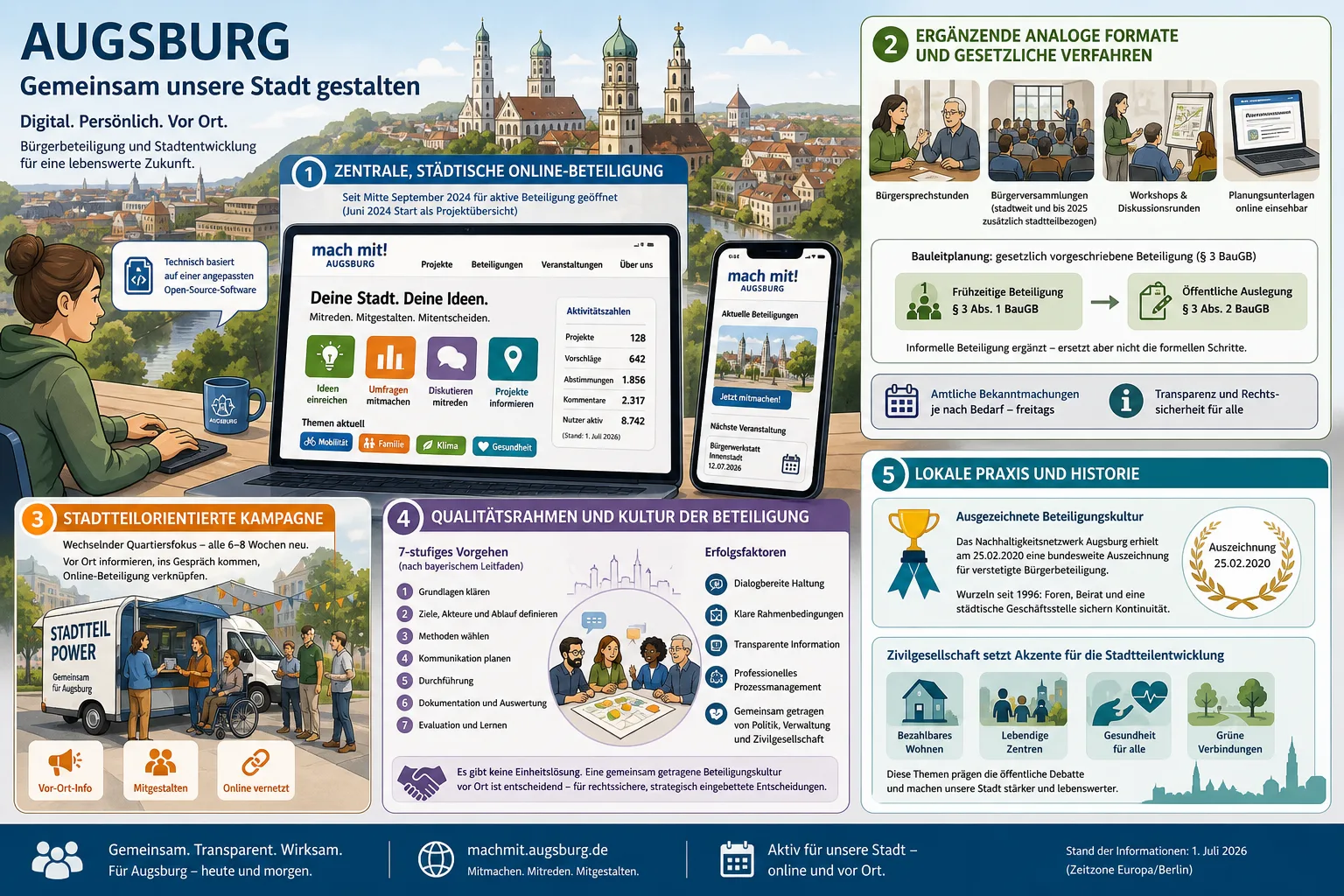
In the coming years, it is expected that Augsburg will continue to bundle participation more digitally – mainly because online formats create reach, make results documentable, and enable participation independent of time.
Which Online Formats Typically Come Up
- Project pages with timelines: Information about the reason, goals, variants, and next milestones.
- Online surveys: Short feedback on options (e.g., design of a square, priorities in cycling, mixed use).
- Map-based feedback (“Map Feedback”): Markings for problem areas (danger spots, missing crossings, fear spaces) or potentials (shade providers, meeting points, green connections).
- Comment functions: Discussion and additions to proposals, often with moderation and netiquette.
How to Participate Online So That It Can Have an Impact
- Provide context: “Why is this important here?” (e.g., school route, local supply, accessibility).
- Specify location: Intersection, block of house numbers, stop, park access.
- Formulate proposal + goal: Not just “more greenery,” but “more shade and infiltration through additional tree plantings and unsealed areas.”
- Consider trade-offs: If you demand something, also name side effects (“parking spaces will be lost,” “delivery traffic needs a solution”).
Important: Online participation is most effective when it is linked with on-site appointments and formal procedural steps (see below). Then feedback is not only visible, but also embedded in the planning process in terms of timing.
On-Site Formats: Participation in the Neighborhood
In the coming years, on-site formats will likely retain a central role because urban development must be experienced spatially: Where does heat arise? Where is a crossing missing? Where is a place avoided – and why? This can often be clarified better together on site than on the screen.
Formats That Can Typically Be Used in Augsburg in the Future
- Neighborhood walks and inspections: Collecting strengths, problems, and ideas together directly in the neighborhood.
- Information evenings: Presentation of goals, framework conditions, variants, and next steps.
- Workshops/planning workshops: Working on maps, guidelines, and drafts (e.g., square design, mobility concepts, open space networking).
- Pop-up stands: Low-threshold conversations at markets, stops, or central squares to reach people who rarely attend evening events.
How to Prepare for On-Site Appointments
- Bring a concrete example: Photo, sketch, short route (e.g., “from the stop to the school”).
- Name priorities: What is a “must,” what is “would be nice”?
- Make your affectedness transparent: Resident, commuter, business, visitor, mobility-impaired – so that statements can be classified.
Formal Procedures According to the Building Code: Where Participation Is Legally Anchored
Regardless of which voluntary formats Augsburg offers in the coming years, there are binding participation steps in land-use planning according to the Building Code (BauGB). These formal steps are particularly important because they create legally regulated time windows with clear responsibilities and documentation requirements.
Typical Process (Simplified Representation)
- Early participation: Information about goals and expected impacts; opportunity to provide feedback and alternatives.
- Public display: More concrete planning documents are publicly available; comments can be submitted.
- Weighing and decision: Submissions are reviewed and weighed against each other; then the formal decision is made.
For you, this means: If you want your contribution to be “on record” in a legally relevant step, use the participation windows of land-use planning and submit a clear, comprehensible statement (short, factual, location-based, with justification).
Quality Framework: How to Recognize “Good” Participation
Good participation is more than “collecting opinions.” In the coming years, you should pay particular attention to the following quality features in participation offers in Augsburg (and in general):
- Clear goals: Is it clear what is to be decided or prepared with participation?
- Clear rules: What is negotiable, what is fixed (e.g., legal requirements, budget, schedule)?
- Transparent documentation: Are contributions summarized, published, and processed in a comprehensible way?
- Feedback (“feedback loop”): Is it explained which proposals were adopted, adapted, or rejected – and why?
- Accessibility: Are there low-barrier locations, understandable language, different times/ways to participate?
The better goals, boundaries, and feedback are explained, the more likely trust will be built – and the more likely contributions can actually be used in planning.
How Your Contribution Becomes Truly Useful for Planning
Urban planning works with trade-offs. So that your idea has a fair chance of being considered in Augsburg in the coming years, this checklist helps:
- Problem precisely: Who has what problem when/where?
- Name intended effect: Safety, quality of stay, climate adaptation, noise reduction, accessibility, inclusion.
- Suggest a solution: A concrete measure or variant.
- Justification: Why is this sensible in the public interest?
- Address feasibility: Space requirements, delivery traffic, emergency routes, maintenance effort, usage conflicts.
If you join forces with neighbors (e.g., as an initiative or thematic group), this can also help, because recurring feedback is bundled and presented more consistently. However, the quality and comprehensibility of the arguments remain decisive.